
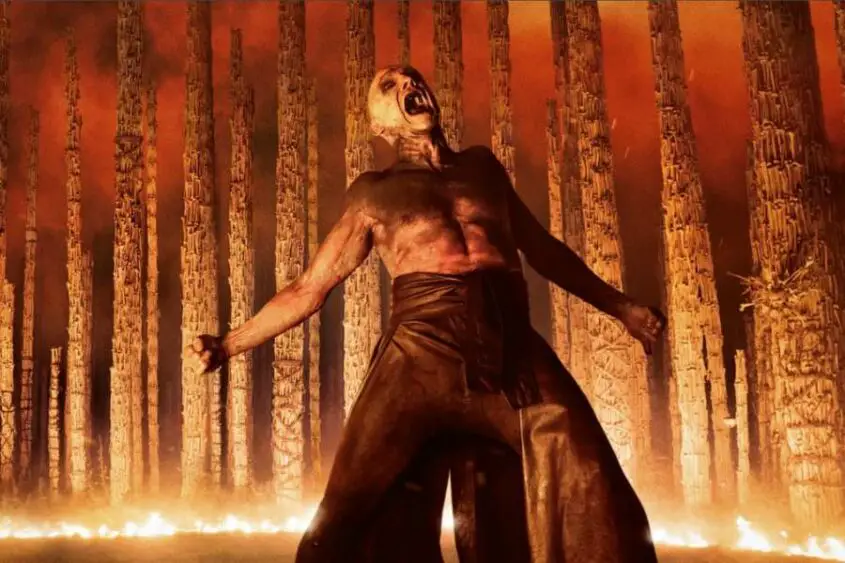
With their slow, uncertain gait, zombies have long embodied our most unspoken fears. The terror of the inevitable. Illness, aging, death itself. An external force that cannot be outrun, only delayed. This is precisely why zombies continue to unsettle us. Born from Caribbean folklore and from the syncretism between African animist traditions and Catholic belief, the undead disturb us not only because they defy nature, but because they represent the erasure of free will.
A body can rise again, but it can rise enslaved. Subjected to another’s control, perhaps that of a voodoo sorcerer—a bokor—and transformed into an instrument of vengeance. In this condition, something buried and violent awakens, driving it to feed with ruthless intensity. The horror deepens when we recognize that this logic already exists in nature: parasites, fungi, and viruses invade hosts, hollow them out, and reduce them to empty vessels. The body becomes a puppet; the Apocalypse ceases to be a biblical nightmare and becomes a psychological landscape, surfacing from the darker regions of the collective subconscious.
Zombies have therefore become indispensable to pop culture. The continued success of The Walking Dead and its countless expansions (spin-off and the original comic book series) or The Last of Us (both series and video game), and of films such as World War Z confirms their enduring grip. Yet the zombie has evolved: slowness has given way to speed, hesitation to frenzy. Works like Train to Busan modernized the myth, reshaping the archetype to reflect contemporary anxiety. From White Zombie in 1932 to the hypnotic melancholy of I Walked with a Zombie in 1943, through Romero’s politically charged reinventions and into auteur parodies like Shaun of the Dead and One Cut of the Dead, the undead have never released their hold on the collective imagination. The arrival of 28 Years Later: The Bone Temple only confirms that this grip remains disturbingly firm.
Zombies as Political and Cultural Metaphor
A new chapter now extends the saga born from the shared imagination of Danny Boyle and Alex Garland, who launched this cinematic cycle in 2002. Long before their intervention, zombies had already embodied fate knocking at humanity’s door (like Beethoven’s Fifth Symphony). It was George A. Romero who ultimately gave the archetype its modern semantic structure; the man himself, the cinephile patriarch who devoted an entire career to transforming horror into political language.
In Night of the Living Dead, the zombie ceases to function as a mere monster and becomes a weapon for cultural criticism. Romero filtered the unresolved tensions of a racist America through horror, releasing the film at the height of 1968. Its devastating ending, where the only Black survivor and true hero is casually executed by a white posse, remains one of the most haunting images in American cinema. For Romero, the zombie was always a vehicle for dissent. The first film echoes outrage over Vietnam, while the final chapter, Day of the Dead (1985), critiques the paranoia and authoritarian drift of the Reagan era.
His sharpest satire, however, arrives with Dawn of the Dead (1977). Set inside a shopping mall, the film transforms consumerism into a grotesque ritual. Baby boomers are a generation of living dead wandering endlessly through the temples of capitalism, repeating in death the empty gestures that defined their lives.
The Undead Archetype in the Contemporary Imagination
Danny Boyle achieved a comparable cultural impact by forging, in the early 2000s, a new nightmare aligned with its time. Between the trauma of 9/11 and the first SARS outbreaks, he launched 28 Days Later. In a deserted post-apocalyptic London, a disoriented Irish courier played by Cillian Murphy awakens from a coma and discovers a city overrun by humans infected with an enhanced rage virus. They are no longer metaphorical corpses. They are hyperkinetic bodies driven by violence. The story of a small group of survivors struggling not only against the infected but against other humans established a new paradigm. These zombies are born from scientific failure; they embody modern anxiety, distrust toward institutions, fear of the future. Most importantly, they run. The break with tradition is symbolic: the archetype itself mutates.
In hindsight, Boyle and Garland’s creatures seem almost prophetic. They resonate with the psychological landscape of the COVID era and with the climate of suspicion surrounding Brexit, portraying an England increasingly isolated within Europe. Horror once again becomes a lens through which reality is filtered. A cruel form of collective exorcism.
The saga reached its apparent conclusion in 2025 with 28 Years Later: the temporal structure evolves from days to weeks (with the chapter 28 Weeks Later, directed by Juan Carlos Fresnadillo in 2007) to years, mirroring an expanding ambition. The latest instalment functioned both as closure and as opening gesture; for this reason, that universe now continues with 28 Years Later: The Bone Temple directed by Nia DaCosta, confirming the franchise’s transformation into a broader narrative ecosystem.
Between Faith and Reason, Superstition and Rationality
Nia DaCosta had already demonstrated her versatility within the horror genre with her 2021 reimagining of Candyman. But this time she inherits a consolidated fictional world and guides it toward a new phase. The film opens exactly where the previous chapter ended, when the young Spike (Alfie Williams) embarks on an initiatory coming of age journey across the infected mainland. He is recruited by the unhinged prophet Sir Jimmy Crystal (played by Jack O’Connell) into a cult of improvised Satanists. At this point, survival becomes a question of abandoning reason in favor of belief. Opposing Crystal’s madness stands the lucid eccentricity of Doctor Ian Kelson (Ralph Fiennes), the only character capable of forging a connection with Samson (played by Chi Lewis-Parry)—leader of a new Alpha mutation of the infected and perhaps the key to understanding or curing the virus.
The allegory is explicit: the world portrayed in The Bone Temple is fractured between faith and reason, superstition and rationality. It recalls the psychological climate experienced during the COVID years and the uneasy return to normality that followed. The lens may be distorted by genre, but the anxiety feels authentic. Here, the true monsters are not the infected—now once again explicitly called zombies—but human beings themselves, capable of cruelty in a ruthless struggle for survival.
Compared with Boyle’s approach, DaCosta’s film marks a clear stylistic shift. Where Boyle destabilized viewers through fragmentation, frenetic pacing, and formal experimentation (involving the use of twenty iPhone 15 Pro Max devices and documentary style inserts to create alienation), DaCosta opts for a more classical language. Her aesthetic occasionally echoes the spectacle of major dystopian franchises such as Mad Max by George Miller; the tone becomes more accessible, though never genuinely comforting. The film operates as a transitional chapter, suspended between narrative arcs, oscillating between moments of disturbing gore and flashes of unexpected irony, particularly in the exchanges between Samson and Kelson and the latter with Crystal.
The film operates as a transitional chapter, oscillating between moments of disturbing gore and flashes of unexpected irony, particularly in the exchanges between Samson and Kelson, and between Kelson and Crystal.
An Atypical Sequel for a Transitional Chapter
This tonal ambiguity may be unintentional, yet it defines the film’s overall effect. 28 Years Later: The Bone Temple often feels like a cinematic roller coaster: exhilarating, unsettling, but ultimately “safe”. A genre experience accompanied by the ritual comfort of popcorn and spectacle for a mainstream audience.
The characters of Kelson and Sir Jimmy Crystal emerge as the film’s true anchors. They sustain a project that appears deliberately imperfect, conceived as an intermediate chapter within a much broader design. Their power lies largely in the performances. Ralph Fiennes and Jack O’Connell imbue these grotesque figures with a fragile balance of credibility and madness, transforming them into reflections of human behavior when confronted with extreme and paradoxical conditions. The result is an atypical sequel, one that distances itself from Boyle’s hyperkinetic style and instead finds identity through convention and through DaCosta’s sensibility. It does not reject the nostalgic impulse that permeates contemporary cinema.
For example, the return of familiar characters (without spoilers!) reinforces this dynamic and offers audiences what genre cinema has always promised. A space for controlled fear. For affordable thrills—cinema ticket price permitting. For the forbidden pleasure of terror itself.