
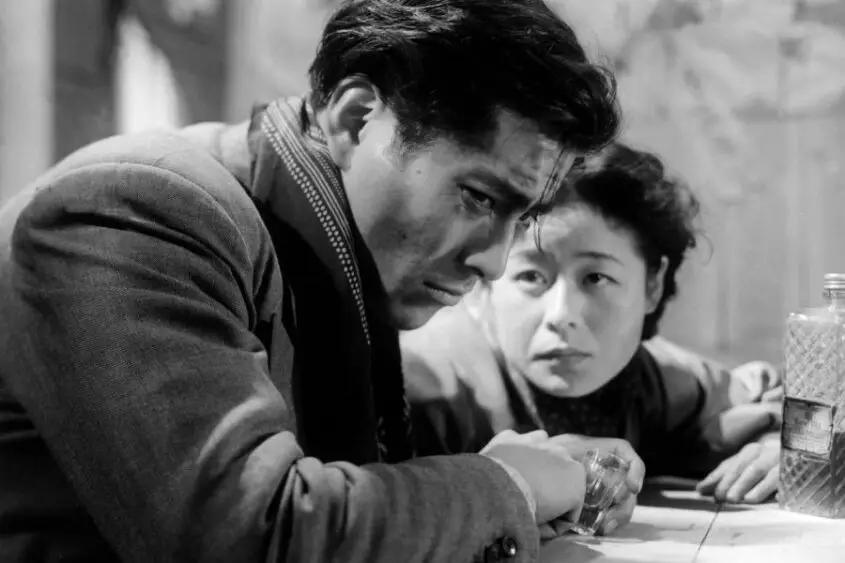
In the cinematic geography of Akira Kurosawa, locations are never mere backdrops; they are the physical manifestations of spiritual crises. The forest in Rashomon (1950) is a labyrinth of truth, the castle in Throne of Blood (1957) a prison of ambition—motifs that echo across many of the masterpieces frequently cited among the greatest Japanese films. But perhaps no location in Kurosawa’s filmography carries as profound an ontological weight as the festering, bubbling swamp at the heart of the black market in Drunken Angel (1948). This swamp, which the film opens by staring into, is not merely a metaphor for post-war Japan; it is the “human condition” itself as seen through an existentialist gaze: a primordial chaos, a meaningless void, and a blind, corrosive force perpetually waiting to swallow any semblance of order and meaning.
Drunken Angel was Kurosawa’s first film made in post-occupation Japan, shot in the rubble of a defeated nation. The black market swamp wasn’t metaphorical for audiences in 1948—it was literal. These festering cesspools formed in bombed-out neighborhoods where the yakuza controlled survival itself. Kurosawa’s existentialism wasn’t abstract philosophy. It was a direct response to a nation searching for meaning in physical and moral ruins. Above all else, Kurosawa’s film is a narrative of two opposing responses to this foundational mire.
Dr. Sanada’s Sisyphean Revolt
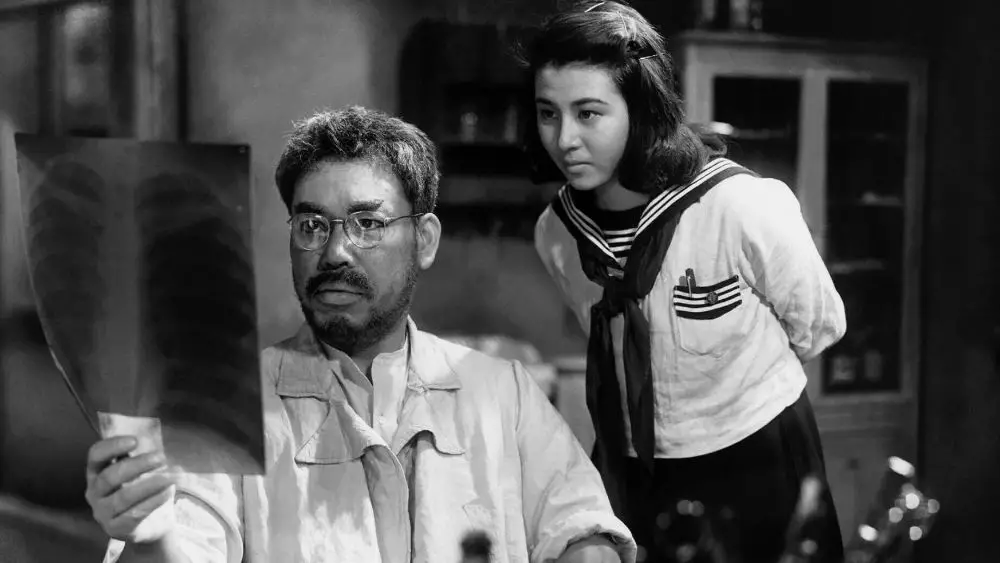
Dr. Sanada (Takashi Shimura), the titular “drunken angel,” is no classic hero. He is a flawed, aggressive character drowning in alcohol. But in Kurosawa’s philosophy, it is these very flaws that elevate him into a consummate existential hero. Sanada is aware of the world’s absurdity (the swamp). He witnesses the collapse of the human body and spirit every day in his humble clinic. His alcoholism is not a simple moral failing but perhaps an attempt to endure the crushing weight of this awareness.
However, unlike so many others, he does not surrender to this absurdity. His actions constitute a “revolt” in the Camusian sense. He knows his efforts may be futile—just as the attempt to clean up the swamp is abandoned halfway through the film—but he finds the essence of humanity in the “relentless effort” itself.
Sanada’s heroism is continuing despite witnessing this failure. He is like Sisyphus, who knows his boulder will roll back down the hill but finds meaning in the very act of pushing it. Every time he shouts at Matsunaga (Toshirō Mifune), every time he violently shoves medicine into his hands, he is injecting “will” into a world that gravitates toward inaction and surrender. His battle with Matsunaga’s tuberculosis is a symbolic war against the forces of entropy and decay embodied by the swamp. He strives to impose a human and moral order upon natural and social chaos.
Matsunaga’s Tragedy of Identity
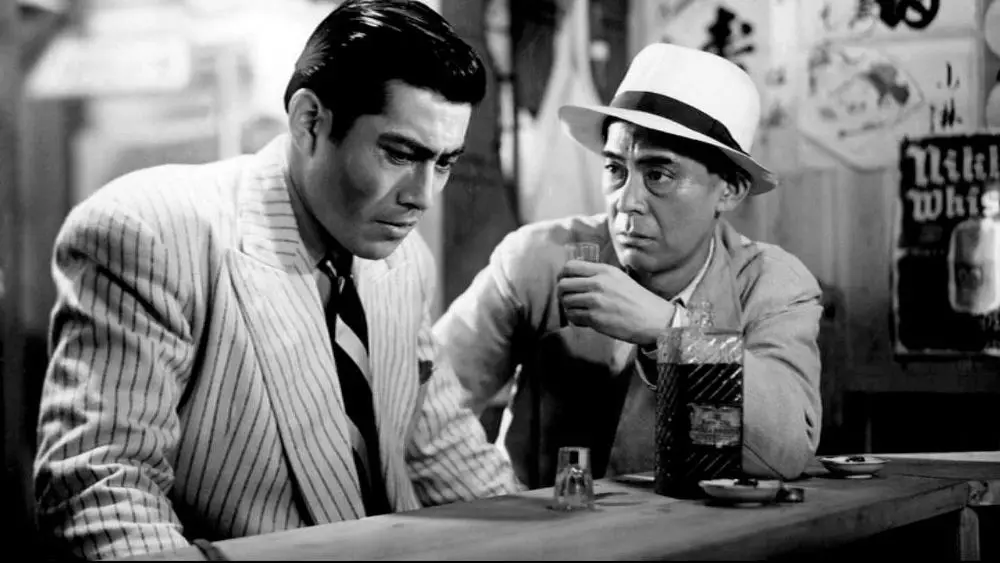
If Sanada represents “will,” Matsunaga embodies “surrender.” Not a passive surrender, but a surrender to a false and destructive identity. Matsunaga is not an individual; he is a “role.” He plays the part of a yakuza gangster with all its prescribed codes of conduct: pride, violence, denial of weakness, and blind loyalty to a hollow structure. The crisp, white suit he dawns, is an armor to escape his own inner void and vulnerability.
Matsunaga’s obsession with keeping his white suit pristine is pathological—he’s dressing his own corpse. By the time he dies in the mud, the suit is finally what it always was: a burial garment soiled by the swamp he refused to acknowledge.
Tuberculosis, this internal enemy, functions as a repressed truth erupting from the depths of his being to tear this mask apart. The disease tells him: “You are mortal, you are weak, you are not the powerful image you have constructed for yourself.” This was Toshiro Mifune’s first major role with Kurosawa, and his feral, twitching physicality as Matsunaga is inseparable from the character’s existential crisis. Watch how he moves—the strutting bravado masking tuberculosis-ravaged lungs, the way his body betrays the mask even as he clings to it. Mifune doesn’t play Matsunaga as a gangster who gets sick; he plays a dying man performing strength, and the performance itself becomes the tragedy.
Matsunaga’s tragedy is not his impending death, but his inability to accept this truth and abandon his persona. His feverish, frenetic dance in the nightclub is the climax of this tragedy: a ritualistic denial of death, a desperate attempt to animate a corpse that is decaying from within. He is so immersed in his role that he would rather die at the hands of another gangster (Okada) than admit his own weakness by accepting his illness. He ultimately becomes a victim of the very code he believed gave him identity and power. His death in the mud is a symbolic return to the same swamp he could never transcend.
Directing as Philosophical Autopsy
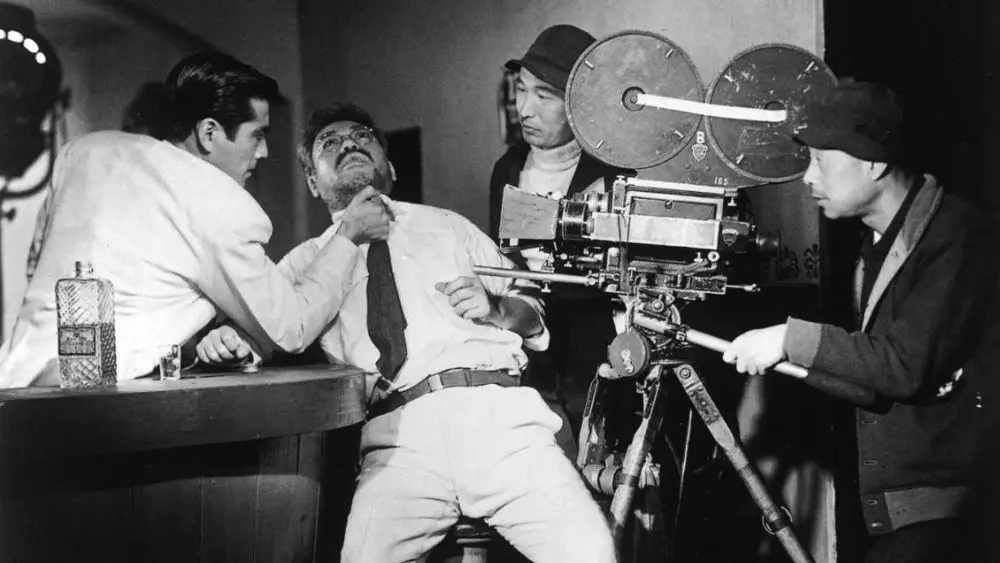
Kurosawa weaves this philosophical struggle not into dialogue, but into the very fabric of his visual language. His camera is not a neutral observer but a tool of moral dissection.
The cramped, suffocating spaces of the clinic, the narrow alleys, and the compressed frames intensify the characters’ sense of imprisonment. The only open space is around the swamp, which is itself another kind of prison.
The film’s atmosphere is thick with a sense of heat, sweat, and suffocating humidity. This is not merely a climatic feature; it is the oppressive weight and stickiness of the “human condition” that presses down on the characters’ souls, making it difficult to breathe (both physically for Matsunaga and spiritually for Sanada).
Kurosawa’s use of loud, jarring Western music (like the “Jungle Boogie” piece) in the nightclub is a brilliant choice. It’s symbolic of a superficial, rootless, and imported modernity that offers no deep relief or meaning. It is the soundtrack to nihilism, a stark contrast to the tense silence of the doctor’s office—where the true battle for meaning is waged.
Redemption in Failure
In the end, Matsunaga dies a pathetic and meaningless death. From a narrative perspective, Dr. Sanada has failed to save him. But from a philosophical standpoint, the film does not end in despair. The ultimate redemption lies not in saving Matsunaga, but in the continuation of Dr. Sanada’s revolt. In the final scene, he continues his work, treating his next patient, a young schoolgirl, with the same characteristic blend of aggression and compassion.
The swamp is still there. The world is still sick and absurd. But one man’s will to confront it, however drunk and unsteady, still burns bright. Drunken Angel does not tell us that we can overcome absurdity; it tells us that our honor is defined by the very act of resisting it. If Rashomon’s forest questions whether truth exists and Throne of Blood’s castle shows ambition consuming itself, Drunken Angel’s swamp asks: what do you do when meaning doesn’t exist at all? Kurosawa’s answer, delivered through a drunk doctor in a ruined city, is his most radical: you create it anyway. This is the film’s greatest and most enduring message. Meaning is something you create, not something you find, and this creation is possible even in the recesses of the darkest ruins.