
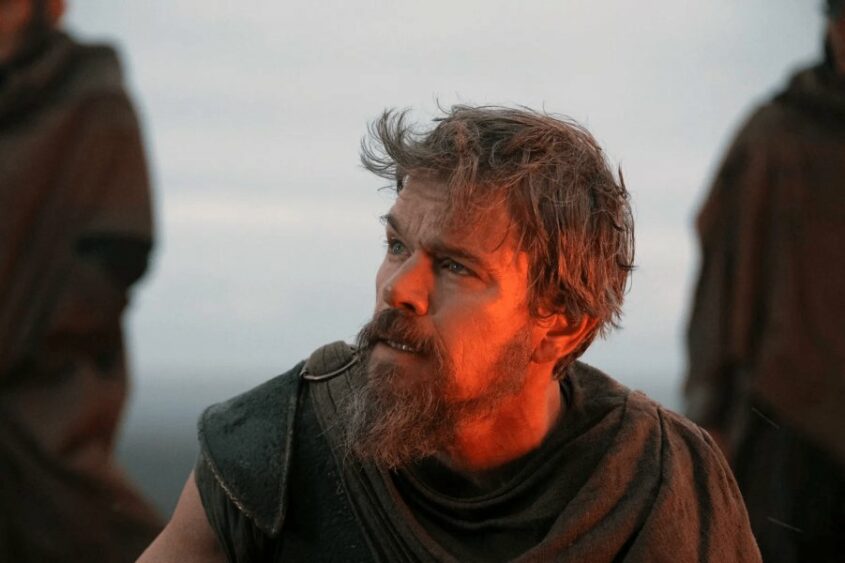
Christopher Nolan said something recently that stopped me completely. In an interview with the Empire Magazine, he pointed,
“When you start to break down the text and adapt The Odyssey, you find that all of these other films – and all the films I’ve worked on – they’re all from The Odyssey.”
Nolan was 5, when he first saw the Ulysses school play in London. It was his first encounter with the story and left a deep impression on him. Nolan might not have known it at the time, but 50 years later, making his 13th film, the connection became clear when he began adapting Homer’s text. His wife and producer Emma Thomas – who holds a degree in Ancient History from University College London – put it best when they first announced the project: “it’s foundational.”
But before we show you every Nolan film where Odyssey has been hiding all along, did you know Nolan shot over TWO MILLION feet of film on The Odyssey across 91 days. He was also originally hired to direct Troy before eventually making this film. He has been circling this story for decades. That is not an accident.
Like The Odyssey, his first movie Following from 1998, has a similar sense of stumbling into adventure. Set in 1990s London, it follows a nameless young man who hangs around people on the street. Seeking inspiration for his writing, the man keeps his distance from the many strangers he tails. However, he will ultimately break this rule when he gets too close and is thrown into the criminal underworld. This isn’t too different from the journey of Odysseus. He could have kept his distance from the dangerous islands of mythical creatures that endangered his men. Even when rules are set, they are broken. The young man catches the attention of Cobb, a burglar who invites him to join him in his breaking and entering. This tantalizing taste of the criminal lifestyle is ultimately a trap. Not unlike the song of the sirens or the food of Circe, Cobb is manipulating the young man. He’s trying to frame this curious and trusting kid as a patsy for his crimes. The temptations of such a man to defy authority become his undoing.
Nolan’s follow-up film, 2000’s Memento, has a more obvious association to the lotus flowers from The Odyssey. In Memento, Leonard Shelby attempts to solve the case of who murdered his wife. But his quest becomes harder to accomplish because of his amnesia. Struggling to recall the past, Leonard relies on clues to piece together his history. What is revealed is a man struggling to seek justice and take note of the consequences of his actions. This is similar to how The Odyssey and the island of the lotus-eaters. Eating the lotus flower causes those who eat it to forget and removes the memory of Odysseus seeking his home. Likewise, Leonard forgets who he is and the case he was pursuing.
Memento can also be seen as the foundation for how he would later write The Odyssey. The film is told in a non-linear fashion from two different perspectives. This format is very much in line with that of Nolan’s The Odyssey. He may not tell the story in reverse order, but he does dice up The Odyssey in a manner that starts with Odysseus trying to remember. The film also favors the perspective of Odysseus’s son to paint a more complete picture of revealing a man’s history.
The sense of exploring dangerous territory is evident in Nolan’s 2002 film Insomnia. Venturing far from his home in Los Angeles, detective Will Dormer seeks to solve a murder in Alaska. However, in tracking down the serial killer, he ends up accidentally killing someone himself. He endangers another life in a foreign land. Complicating his problem is the presence of the serial killer Walter Finch.
Nolan’s grandest arc of filmmaking was his revered Batman trilogy. Starting with Batman Begins in 2005, the director took a very different approach to the comic book hero. His version of Batman would be grounded in a world more real than Tim Burton’s macabre surrealism. But the story still carried an essence of the mythical through its realism. Consider how Nolan frames the villainous Doctor Crane, aka Scarecrow. He appears as a monstrous figure who evokes fear in others. But it’s only with the aid of his spooky mask and fear-inducing toxin that makes him a monster. Scarecrow uses these tools to torture Batman, taking advantage of his trauma. The villain becomes a nightmarish figure.
Bruce forms a romance with Rachel, but he denies it until Gotham no longer needs Batman. This can be read as Odysseus leaving behind his wife, Penelope, to wage the Trojan War. Although Bruce never leaves Gotham City, he does leave behind his home as he burns Wayne Manor to the ground. The journey home will become as difficult as Odysseus becoming lost. Bruce will now have to completely rebuild a place he can call home, and it won’t be easy to seek such comfort again.
2008’s The Dark Knight has Batman coming to terms with not being able to save everyone. In the same way that Odysseus loses many men on his voyages, Bruce Wayne also loses an abundance of people in Gotham City. The chaotic force of The Joker targets those close to Bruce. He is unable to prevent the death of his ex-girlfriend Rachel. He fails to pull back his pal Harvey Dent from being consumed by probability-based justice that ultimately dooms him. In the same way that Circe turns the men of Odysseus into pigs, The Joker transforms the citizens of Gotham into a state of panic where they turn on each other. The people Bruce thought he once knew no longer become themselves, fighting against each other for their own survival. Obviously, the one person who undergoes the greatest transformation is Harvey Dent. Going from being the revered DA to a charred serial killer is a concerning shock for Bruce.
2012’s The Dark Knight Rises might be the closest association with The Odyssey given the story. This is mostly due to Batman’s absence from Gotham City after his defeat at the hands of Bane. His back is broken, and he is tossed in a deep pit. Battered and lost, Bruce Wayne must recover and find his way back home. This requires more than just some time to heal and an escape plan. The journey back has Bruce Wayne confronting ghosts of his past and finding the inner strength to get back in the fight. With Bane and other villains taking over Gotham, Batman needs to return and clean house, no different from Odysseus taking back the throne. Although beating back Gotham’s worst and saves the city, Bruce can’t carry on the fight. He passes the mantle of the city’s hero onto John Blake, becoming the next generation of heroes and leaders. It’s a passing of the torch, reflecting how Odysseus grants the throne to his son, who is committed to his father’s ideals.
The entire Batman trilogy reflects the tribulations Odysseus faces. Batman’s villains can be read as the monsters, witches, and gods that attacked Odysseus’s men and prevented him from finding his way back home.
Of course, Odysseus’s journey lasted far too many years and took him away from his loved ones. The one Christopher Nolan movie that highlights this long, draining adventure of isolation is 2014’s Interstellar. Set in a dismal future, NASA pilot Coop must venture into space for a solution. The space adventure will take him far from Earth and make time pass much more slowly abroad. The difference between Coop and Odysseus is that Coop still receives messages of his daughter growing up without him. It makes the journey that much more painful, but just as emotional for the longing for home so far away.
The memory-removing lotus flowers of The Odyssey are most vocal in 2010’s Inception. The thrilling mental journey of manipulating dreams is easy to get lost in. As Cobb and his team descend into dreams within dreams, he finds himself haunted by the past and a desire to remain locked into the dreamworld forever. Even when knowing the rules of his dream-diving expeditions, Cobb still succumbs to the traps. He loses touch with reality and risks losing his mind. In the same way Odysseus believed he could bravely lead his men anywhere, Cobb ends up endangering himself and others by not keeping his limits in check. It takes more than firepower and ambition to survive the trippy and violent landscape of chaotic dreams. Likewise, it takes more than an army and weapons to return to Ithaca.
Part of what throws Odysseus off in his quest is a deception. The illusion of a way home or something more desirable is present in 2006’s The Prestige. The film is all about magic and illusion, but reveals a more disturbing reality involving teleportation. The Great Danton reveals that his ability to escape death traps has nothing to do with manipulating his body. It’s all about clones: the fake one dies, and the original lives on. It’s such a morbid revelation, no different from how Odysseus discovers his men being turned into pigs.
The crucial time spent away from Ithaca takes a toll on Odysseus, where every move is crucial to find a way back home. 2017’s Dunkirk is a Nolan movie entirely about returning from war, specifically the Battle of France. Falling back to Dunkirk leads to a daring rescue operation where many soldiers will not survive. Although the operation does not take as long as Odysseus’s trek, it is still a draining experience when viewed from multiple perspectives. The conclusion of how many soldiers survived with the help of military and civilian craft showcases a devotion amid death.
Odysseus fights back against powerful forces within The Odyssey, but also realizes his limits about how much of his fate he can change. Destiny becomes a big deal in 2020’s Tenet, a sci-fi thriller all about time manipulation. The character only referred to as Protagonist discovers an ability to force objects and people in reverse. This manipulation of time threatens to destroy all of existence if he doesn’t learn to work with more experienced men. The disorienting nature of Tenet reveals a cyclical nature of time distortion. It doesn’t matter what goes backward or forward in this narrative. The turning back of the clock is still the result of the same clock, following a rigid track of events. The surreal moments of backward-moving cars, people, and guns have all been destined to turn a certain way. The Protagonist is, in effect, defying higher powers that control his fate. And while he might continue the fight, there are certain events he cannot change by the very nature of time. The time-altering tech of Tenet evokes Odysseus defying forces far beyond his control.
But when it comes to defying gods, it’s impossible not to see that tampering with danger in 2023’s Oppenheimer. The historical drama follows J. Robert Oppenheimer’s development of an atomic bomb. This new weapon would change the face of war and brew a level of regret within this scientist for what he has unleashed. As Oppenheimer remarks on his creation, “I am become Death, destroyer of worlds.”
Oppenheimer is maybe one of the most important movies for how Nolan would form The Odyssey. The non-linear format for the movie painted a more complete picture of Oppenheimer from multiple perspectives. Rather than retell his story by going from point A to point B, the film distills the historical events into their most important emotional moments. We know the political fallout is coming as much as the radiation from the post-explosion hearings following pre-explosion research. The same approach was taken in The Odyssey, where the old story is edited in a way that is more revealing than recounting it.
Perhaps Nolan wasn’t consciously referencing The Odyssey throughout his work. But it was always there – the story that found him at five years old in a school hall in London and never quite let go. You can see it now, looking back across thirteen films. The Odyssey isn’t just Nolan’s latest film. It’s the one he’s always been making.
