

The throughline of beloved Hollywood filmmaker Rob Reiner’s career has always been heart. From his directorial debut in 1984’s This Is Spinal Tap (cue that hilarious musical “mockumentary,” a film genre that Reiner electrifyingly popularized), to his final directorial swansong in 2025’s Spinal Tap II: The End Continues, Reiner was a director who always wore his heart on his sleeve. His dark, tragic, unexpected death back in December has consumed the sad media headlines since, and this audience pain is doubly felt for a person who emanated such light and warmth. The dichotomy doesn’t go unnoticed.
But today, on what would have been Rob Reiner’s 79th birthday, let’s look back at some of this stellar Oscar-nominated filmmaker’s earliest and brightest films. Launching his Hollywood career as an actor in the 1970s TV comedy sitcom All in the Family (hello lovable Meathead!), and later branching out into the filmmaking avenues of writing, producing, and directing, Rob Reiner was a prolific showbiz powerhouse.
Ask someone what some of their favorite films are from the 1980s and ’90s. Chances are there’s at least one Rob Reiner-directed film on the list. In mainstream cinema, his films had a sky-high likeability quotient. What’s more, if listing two or more Rob Reiner films, chances are each film is intriguingly different from the other. Not only was Rob Reiner known for imbuing each of his films with that simultaneously strong, vulnerable, sweet, and passionate human organ called “heart,” but also for choosing to make films whose stories spoke to him personally and therefore weren’t bound by genre. After all, as humans we experience a huge range of emotions.
From the gates of Hell with dangerous author-uber-fan Annie Wilkes in the snowy horror flick Misery (1990), to the high-maintenance romantic comedy When Harry Met Sally… (1989), Reiner traversed the wide spectrum of the human condition in the most magical of ways. Good? Evil? He was taking us along for that wild human ride. Á la Jack Nicholson in Reiner’s riveting Oscar-nominated courtroom drama A Few Good Men (1992), can we “handle the truth?” Further, what about fantasy romance? Fear not, Reiner was masterful at that, too. Hello, 1987’s The Princess Bride.
The Popularization of the Mockumentary
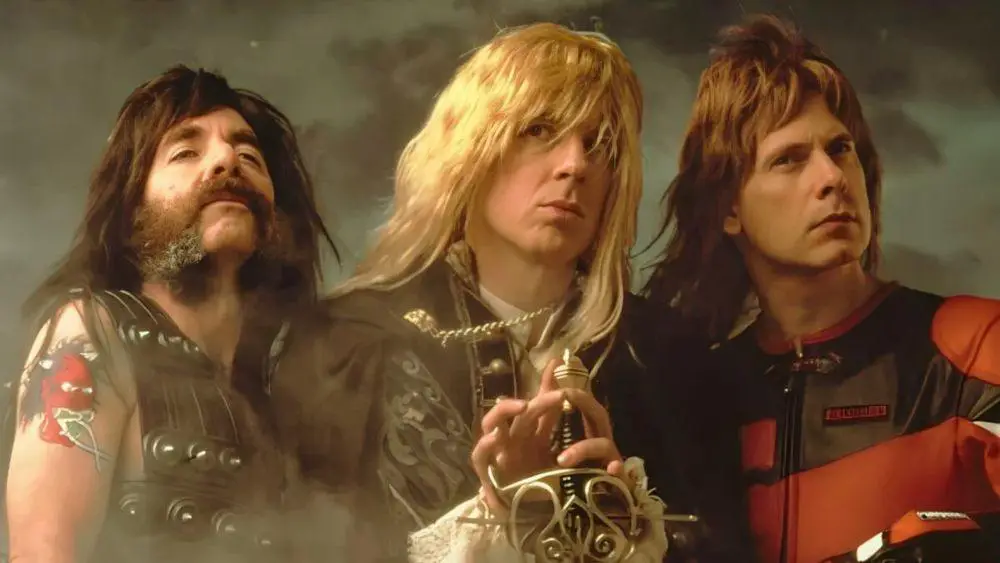
Though 1950s and ‘60s cinema had a few “mockumentary” outings, it was novice film director Rob Reiner who opened the genre up to the masses. And how. His 1984 directorial debut of This Is Spinal Tap, which Reiner also co-wrote and starred in, was a smash hit. Though not running strong out of that initial box office gate (cut to bemused 1984 movie-goers thinking, “What’s a mockumentary?”) the film went on to achieve “cult classic” status. For decades now, it has grown an obsessively devoted fanbase. Think Star Wars or MCU. This is in addition to the film’s critical acclaim.
A story about a fictitious English rock band, Spinal Tap, during those hedonistic 1980s heavy metal hair-band days, This Is Spinal Tap goes on tour with this “tea and crumpets” band as they cris-cross the vast expanse of Yankeeland USA. Almost entirely improvised, the film is a sharp comedic satire that exposes the absurdities, excesses, and maladies of fame—particularly those surrounding heavy metal stardom. Presented in mockumentary style, it unfolds like a serious documentary, and therein lies the film’s next-level hilarity and brilliance.
Starring Christopher Guest, Michael McKean, and Harry Shearer as the iconically bad, but thoroughly entertaining primary band members, the film is chock full of priceless scenes. Standouts include the guitar amplifier that “goes to 11,” the illustrated renderings of the band members’ astrology signs by the “creative” on-the-road girlfriend, and of course, the “descending to the stage” miniaturized Stonehenge.
All this is captured via seemingly impromptu band interviews, realistically “shaky” and “fidgety” camera work, and other seemingly realistic documentary-style elements. Then add in Reiner himself, who stars as Marty, the so-called documentary filmmaker who is accompanying the band on tour.
Watch Reiner as he earnestly listens to McKean and Guest describe the demise of a former band member. Classic McKean line: “He died in a bizarre gardening accident.” It’s followed up by the classic Guest line: “The authorities said, you know, best leave it unsolved really.” Hilarious. Audiences forever remember Reiner sporting his blue cap, and listening with such sincerity to these kooky, lovable musicians. Wink.
The Fantasy Romance Everyone Wished For
Not to be outdone by heavy metal shenanigans, Reiner next pivoted to the touching coming-of-age friendship drama Stand by Me (1986), which, like This Is Spinal Tap, received high critical acclaim for Reiner’s skillful directing efforts. Reiner, once waxing nostalgic over his many films, said recently of Stand by Me:
“It’s the one (film) that meant the most to me because it really is an extension of my personality and sensibility. It has a mixture of humor and melancholy and emotion and it’s something that is the closest to me of all the films I’ve done.”
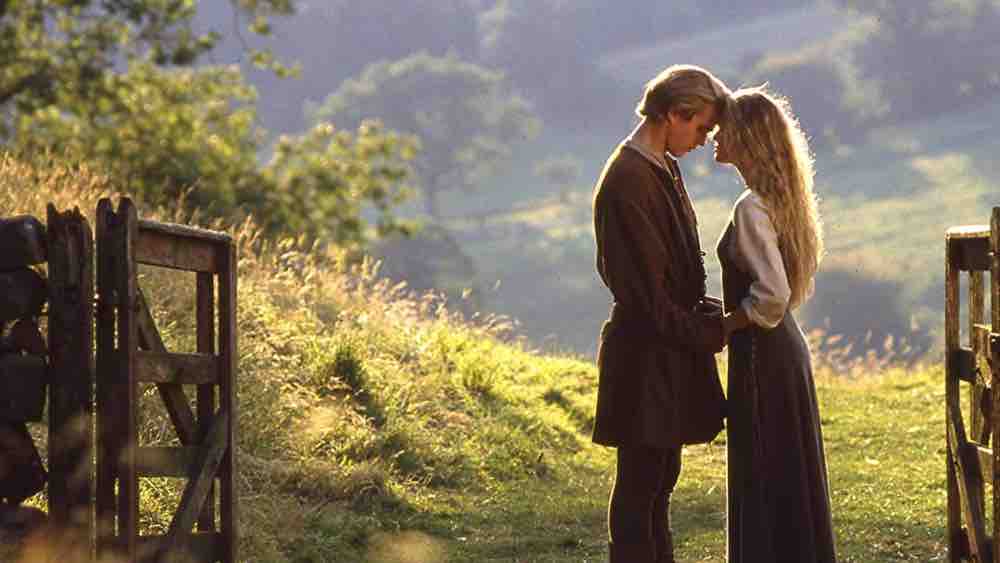
A year later, Reiner landed on the wondrous, comedic fantasy romance The Princess Bride, which he also produced. A tale of love, separation, vendettas, and more than one cup of poison, all set in the far-off fictitious medieval-looking land of Florin, The Princess Bride left movie-goers bemused. But why? For starters, it has an intriguing “frame story.” The film opens in modern-day, with legendary actor Peter Falk as a grandfather visiting his preteen grandson who’s home sick from school. He starts reading his grandson this wondrous story from a book, and it’s not without a few misgivings that the grandson listens.
And so continues The Princess Bride. The film shifts back and forth between the frame story and the book narrative, and it does so in the cleverest and most heartwarming of ways. The result is a movie that allows for audiences to feel connected to all characters in both “cinematic spaces.” Cut to early on, where the grandfather describes to his grandson the kissing that is taking place between the story’s two main characters of Buttercup and Westley. The grandson butts in very apprehensively, “Is this a kissing book?” Cute stuff.
But unsurprisingly it’s the “fantasy romance” book narrative where Reiner’s directorial talents truly shine. He brought out resonant, career-defining performances from both novice and established actors. Enter Robin Wright of future Forrest Gump (1994) fame. This is one of her first films, and audiences forever adore her as the aforementioned Buttercup. Classic Fire Swamp line: “You mock my pain!”
Then established Tony award-winning Broadway theater actor Mandy Patinkin, also of Yentl (1983) film fame, will forever be known for his swashbuckling Inigo Montoya character, who is charismatically on the lookout for the person who “bone-orcharded” his dad. Classic line: “Hello. My name is Inigo Montoya. You killed my father. Prepare to die.”

Reiner was showcasing captivating subject matter, unique storytelling techniques, sparkly dialogue, an understanding of his actors and how to elicit memorable performances, perhaps due to his own extensive experience as an actor.
Just as director Steven Spielberg is synonymous for action, adventure, imagination, and being able to tap into the cultural zeitgeist, Rob Reiner movies are filled with magic, humanness, and love, that also tap into the cultural zeitgeist. In Misery (1990), Reiner approaches the villainous Annie Wilkes with compassion. Though she is clearly dangerous and unhinged, he still allows the audience to understand—and perhaps even empathize with—her obsessive devotion to the famous writer she has imprisoned in her home. Full disclosure, maybe audiences truly need to “see to believe” this one! But, all told, Reiner knew how to show “heart.”
The Romantic Comedy Masterpiece
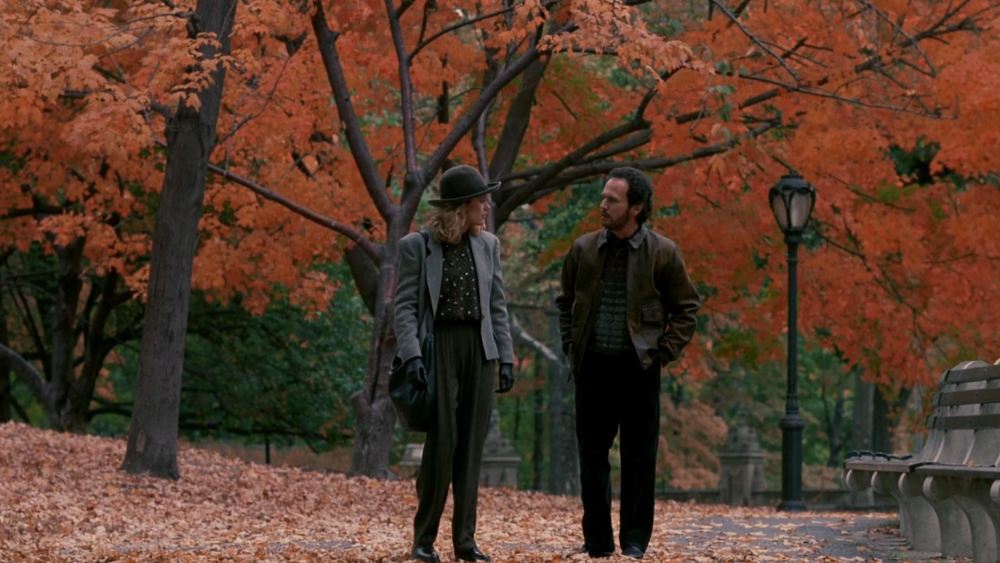
Some movie genres get more high praise and accolades than others. Drama? A whole lot of awards. Epics? Traditionally revered. But comedy, and specifically romantic comedy? Be prepared for crickets. However, that didn’t deter Rob Reiner from directing the now iconic, legendary romantic comedy When Harry Met Sally.
Ranked a wildly impressive #25 on AFI’s 100 Passions list (2002), and #6 on 10 Best Romantic Comedies list (2008), When Harry Met Sally… remains essential viewing.
A tale about two college grads who share a road trip from Chicago to New York City, and then embark on over a decade of relationship variations (acquaintances, friends, lovers, enemies, and then possibly something else?), When Harry Met Sally… defies the naysayers who don’t believe that romantic comedy can achieve “masterpiece” status.
Billy Crystal, Meg Ryan as the titular Harry and Sally embody perhaps their most beloved roles with nuance, charm, and ease. Here’s only guessing that Reiner’s extensive experience as an actor greatly informed this film. He ultimately helped bring Crystal and Ryan to that touching, unforgettable New Year’s Eve “finale” finish-line, magically doused in bubbly champagne, confetti, and all.
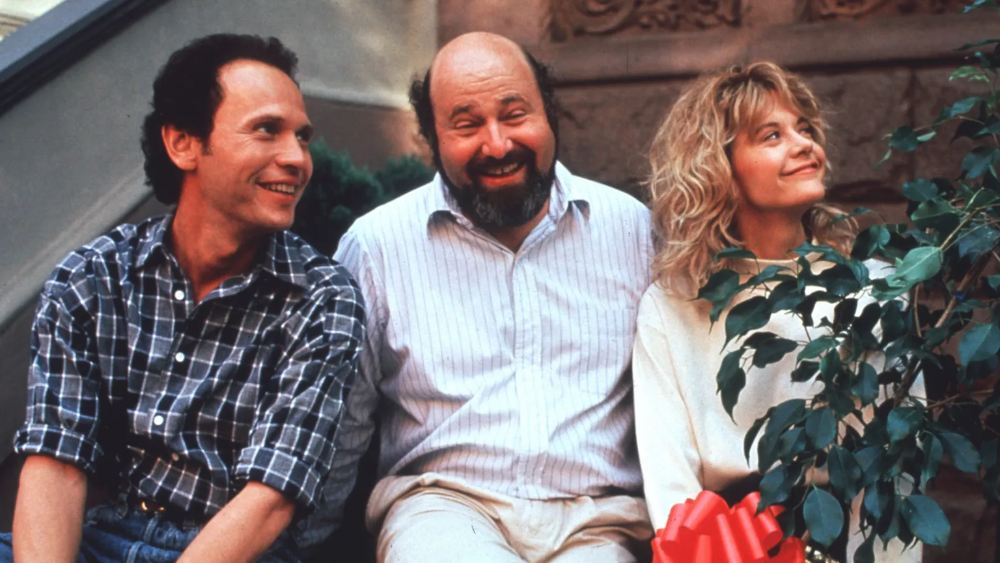
Alongside powerhouse Nora Ephron who famously wrote the film’s sparkly script (and was nominated for more than a few awards for it), Reiner re-popularized the rom-com genre. Not since the 1930s and ‘40s with films like The Awful Truth (1937) and Bringing Up Baby (1938) had audiences fallen so head-over-heels for love and laughter. Reiner tapped into what movie-goers cherish.
Further, like The Princess Bride, where in addition to eliciting memorable performances from his actors, and utilizing sparkly dialogue, Reiner was showcasing captivating subject matter, and telling its story in a unique way that was filled with heart. Can men and women be friends, especially in the “sophisticated rough and tumble” of megacity New York City? Reiner is off and running, showing us the many “pull at your heartstrings” possibilities. Noteworthy, Rob Reiner’s mother makes a cameo in When Harry Met Sally… She’s the woman in the deli who dryly says: “I’ll have what she’s having” in Meg Ryan’s unforgettable, blush-worthy “orgasm” scene. Priceless.
Rob Reiner’s Positive Legacy
From Reiner’s 20+ directorial movie catalog spanning 1984-2025, three movies—This Is Spinal Tap, The Princess Bride and When Harry Met Sally—have been inducted into the USA’s National Film Registry, a government program that highlights and preserves American films of “cultural, historical, or aesthetic significance.” Covering a swath of genres, the selection spans Old Hollywood’s classics like The Wizard of Oz (1939) and Casablanca (1942) to New Hollywood landmarks such as The Exorcist (1973), Chinatown (1974), and All the President’s Men (1976). More recent additions range from Brokeback Mountain (2005) and Inception (2010).
For a man who gave so much love to the film industry, through many movies over many years, here’s hoping talented Rob Reiner felt that love from all of us in return.
