
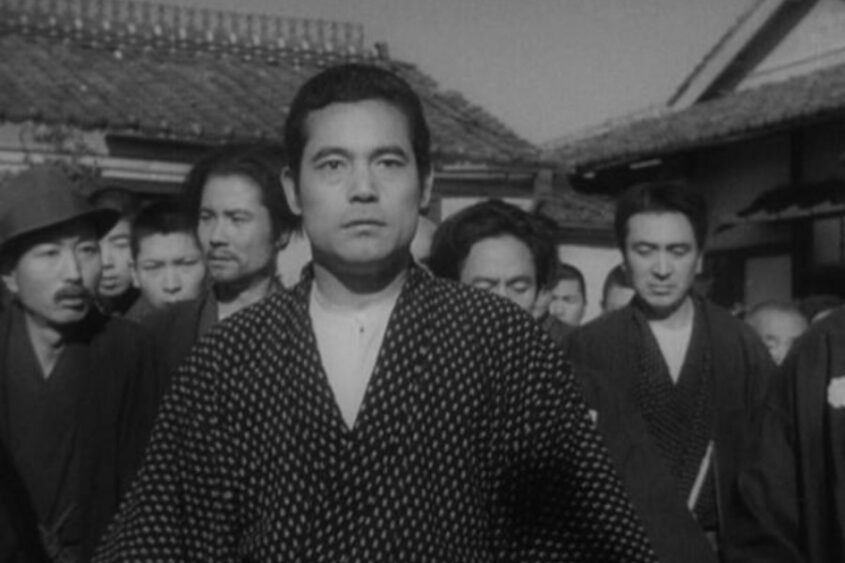
Sanshiro Sugata (1943), Akira Kurosawa’s debut film, is more than a mere introduction to a fledgling director; it is the cornerstone of a worldview and the philosophical concerns to which Kurosawa would remain faithful throughout his career. At first glance, the film tells the story of the rise of a new martial art, Judo, and its young champion, Sanshiro Sugata. In its deeper layers, however, Sanshiro Sugata is a powerful spiritual allegory about the human journey from raw arrogance to tempered wisdom, from aimless violence to purposeful strength, and from mere “technique” to “The Way” (Dō).
That Kurosawa chose to tell this story in 1943—at the height of Japanese imperial expansion, under the watchful eye of a military government that actively censored films it deemed insufficiently nationalistic—makes its quiet individualism all the more remarkable. This essay argues that Kurosawa, through the conflict between Judo and Jujutsu, the master-student relationship, and especially the central metaphor of the lotus flower, depicts an inner journey to discover the true meaning of strength. In doing so, he produced what amounts to a subversive document: a film in which the ultimate victory is the conquest of the self, not of an enemy—a deeply personal ethos at odds with the collective sacrifice the state was demanding of its citizens.
The Dialectic of Power
The dramatic heart of the film beats in the conflict between two martial philosophies. Jujutsu, the traditional martial art, is portrayed as a symbol of brute force, ego, and a win-at-all-costs mentality. Its practitioners, particularly Sanshiro’s main rival, Gennosuke Higaki, are men whose power serves the self. In contrast, Judo’s master, Shogoro Yano, teaches an art that is a “path” or “The Way” (Dō). Judo is founded on the principle of jū yoku gō o seisu—”yielding to overcome”—using an opponent’s strength against them. This is not merely a technical disagreement but an ideological battle. Kurosawa uses this framework to ask: what is true strength? Is it the physical ability to dominate another, or the capacity to master oneself and wield power in service of a higher purpose?
It is worth pausing on Higaki, whom the film refuses to make simple. He is not a crude thug but a man of genuine skill and a kind of cold, self-aware pride—he knows what he is and has chosen it. Kurosawa affords him an almost tragic dignity, and this is characteristic: even in his debut, Kurosawa was incapable of writing a villain without complexity. Higaki’s defeat matters precisely because he is formidable; it would mean nothing to defeat a lesser man. At the film’s outset, Sanshiro is himself the embodiment of Jujutsu’s raw, aimless force, which is to say he and Higaki begin from the same place. The film’s arc is the story of a divergence—one man finds a path, the other does not.
The Crucible of Discipleship
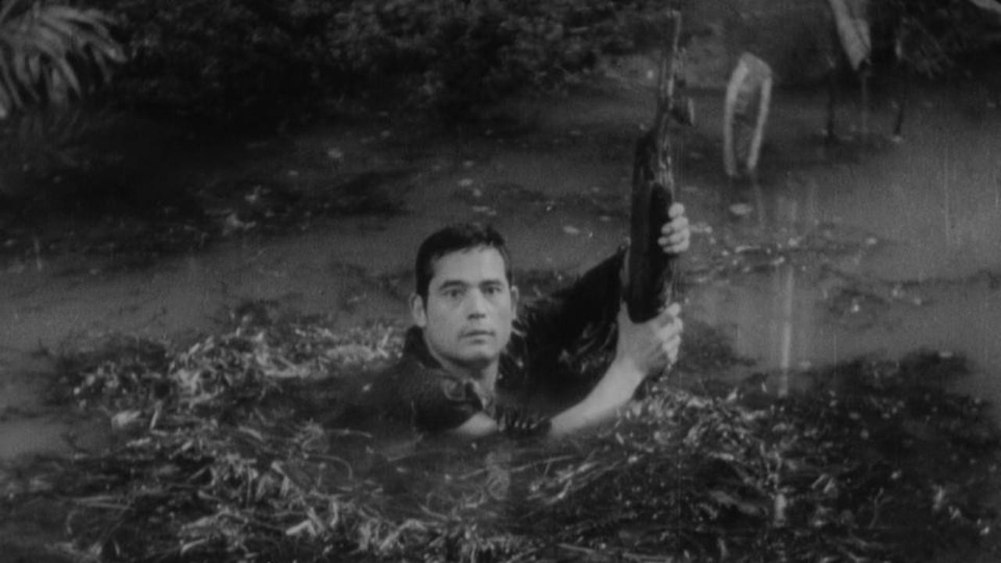
Sanshiro’s transformation would be impossible without his master, Shogoro Yano. Their relationship is a quintessential example of the sensei-student bond in Japanese culture—and the first iteration of a dynamic Kurosawa would return to repeatedly, most fully in Red Beard (1965) and Kagemusha (1980). The master does not just teach technique; he polishes the student’s soul. The story’s turning point comes when the arrogant Sanshiro defies an order, and his master declares him unworthy of his tutelage. To prove his commitment, Sanshiro resolves to spend an entire night clinging to a wooden post in the temple’s cold pond.
This beautifully shot scene is not a mere punishment; it is a crucible. Kurosawa films it with remarkable restraint—there are no close-ups of anguish, no swelling score to instruct us how to feel. Instead, he holds the camera at a distance, letting the stillness of the water and the slow passage from darkness to dawn do the work. The suffering is implied, not performed. The icy water symbolizes the hardship that purifies his rebellious ego. It is a baptism in which the old Sanshiro “dies” so that a new one may be born. Kurosawa himself, in his memoir Something Like an Autobiography (1982), described his admiration for the original novel’s author, Tsuneo Tomita, and spoke of Sanshiro’s ordeal as the scene around which the entire film was conceived—the emotional and philosophical centre from which everything else radiated.
The Lotus Blossoming from the Mud
Kurosawa crystallises the philosophical climax of his hero’s transformation in a single, potent image. As Sanshiro nears collapse in the freezing pond, the rising sun reveals a lotus flower blooming. This pure, beautiful blossom emerges directly from the same filthy, muddy water in which he has suffered all night. This is an epiphany—a moment of satori. Sanshiro understands, in that instant, that true beauty, purity, and strength (the lotus) are necessarily born from suffering, humiliation, and the struggle with one’s own darkest aspects (the mud).
The lotus image is drawn from deep wells of Buddhist and specifically Zen iconography, in which the flower (padma in Sanskrit) represents the capacity of the human spirit to rise toward enlightenment from the murk of delusion and desire. Kurosawa was not a religious filmmaker in any orthodox sense, but he was steeped in this imagery, and he understood its power to communicate without argument—to land on the audience as felt truth rather than stated lesson. The choice to make this revelation visual rather than verbal is precisely what separates it from a parable and makes it cinema. From this point on, Sanshiro’s fights are no longer about proving himself; they are a practical expression of this philosophy. He no longer merely “fights”. He lives The Way.
Kurosawa’s Visual Language
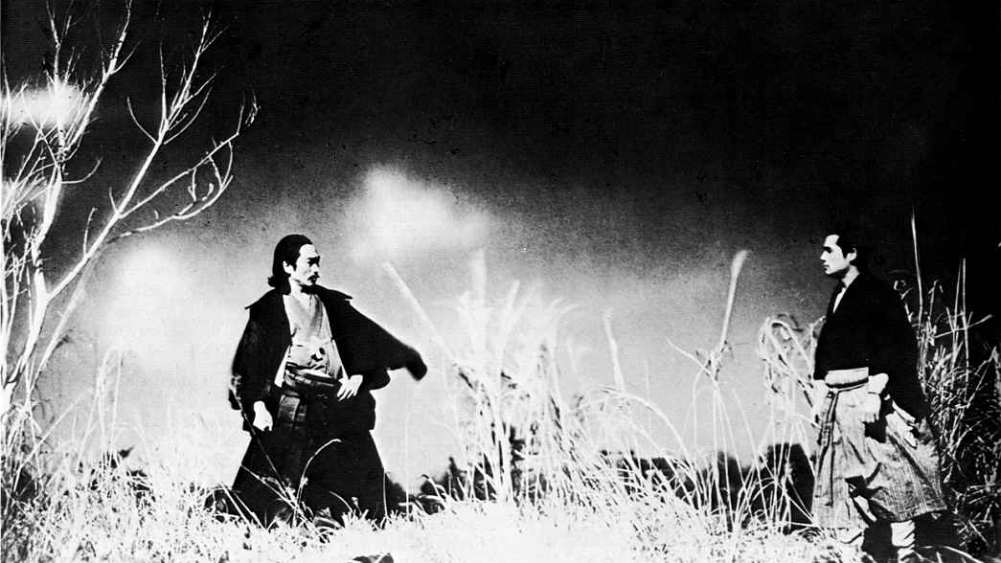
Even in his first film, Kurosawa’s visual signature is unmistakable. He uses nature not as a decorative backdrop but as an active participant in the drama. The most famous example is the final duel between Sanshiro and Higaki on a windswept highland, with the tall grass whipping relentlessly around them. This furious wind isn’t just a weather phenomenon. It’s the visual manifestation of the characters’ inner turmoil, the epic scale of their conflict, and the elemental forces that govern human destiny.
This technique—what we might call Kurosawa’s pathetic fallacy, though it operates with far more structural rigour than that term implies—would become a defining feature of his mature work. The rain in Rashomon, the fog in Throne of Blood, the fire in Ran: all are extensions of this same instinct, first exercised here. What distinguishes Kurosawa from directors who merely use weather atmospherically is that his natural forces feel morally weighted. The wind in the final duel does not just look dramatic; it feels like a reckoning. In doing this, Kurosawa elevates a one-on-one fight into mythic drama. The filmmaker shows his hero’s journey as part of a larger cycle within nature and the cosmos.
Making Art Under the State
Any serious reading of Sanshiro Sugata must reckon with the circumstances of its production. The film was made under Japan’s wartime censorship apparatus, the Cabinet Information Bureau, which required scripts to be submitted for approval and demanded that films contribute to the war effort. Kurosawa’s film was passed—but only after the censors cut approximately eighteen minutes of footage, which has never been recovered. The reasons for those cuts remain speculative, though Kurosawa later suggested the censors found the film insufficiently “Japanese” in spirit, perhaps objecting to its emphasis on individual spiritual development at a moment when the state required self-abnegation.
What survived is a film whose values—humility, inner discipline, the subordination of ego to a higher principle—could superficially be read as compatible with bushidō and martial sacrifice. But Kurosawa’s emphasis is crucially different. Sanshiro’s goal is not to serve the state or defeat an external enemy but to become, in the fullest sense, himself. This is an individualist film made in an age of enforced collectivism. The fact that it survived the censors, in whatever truncated form, is itself a small act of cultural resistance.
Conclusion
Sanshiro Sugata is far more than the origin story of a national sport or an auspicious debut. It is Akira Kurosawa’s artistic and philosophical manifesto—a prelude to all his future masterpieces. And a document that rewards reading both on its own terms and against the historical conditions that shaped it. The story of Sanshiro is the story of every person in search of the true meaning of strength and selfhood. He teaches us that true mastery is found not in defeating others, but in conquering oneself. And that the most beautiful flowers always blossom from the darkest, muddiest waters.
But it is also worth noting what Kurosawa does not do: he does not resolve all tension neatly. Higaki is defeated but not redeemed; the world does not become peaceful because one young man found The Way. Kurosawa was too honest a filmmaker to offer that kind of consolation. The lotus blooms, but the mud remains. That ambivalence—the insistence on holding idealism and hard reality together in the same frame—is perhaps the most Kurosawan thing of all, and it was present from the very first film.