
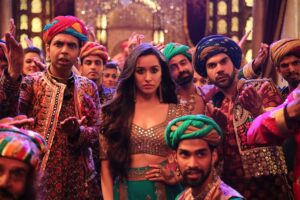
Like all unusual, inexplicable ghost stories we’ve grown up watching, here too we’re served with a tale that defies easy explanations but one that draws you right in. There’s no time for why-abouts when you’re already warned with a ‘based on a ridiculous phenomenon’ disclaimer. Credits to the writers (Raj Nidimoru and Krishna DK) and the director (Amar Kaushik) who keep you riveted in this imaginative tale, one that, in lesser hands, could have collapsed into outright silliness. Horror comedy is a barely explored genre, if not a completely un-walked territory for Hindi cinema. We’ve only scratched the surface. But with Raj and DK’s zombie horror Go Goa Gone (2013) and now Stree (2018), we’ve come a step closer to justifying the genre.
What separates Stree from most genre exercises in Bollywood is that it understands its horror and its comedy as two expressions of the same anxiety. The ghost at the centre of the film, a woman scorned, spurned, and ultimately wronged by the men of Chanderi, is not simply a narrative tool. She is the town’s collective guilt made flesh. The men of Chanderi write “O Stree, kal aana” on their walls not out of superstition but out of a deeply conditioned reflex: defer the woman, delay the reckoning, keep her at arm’s length. That the film turns this into comedy is not a deflection. It is the point. The horror of Stree is not what the ghost does. It is what the men deserve.
Most effective social satire lets you laugh first and think later. Director Amar Kaushik and his writers understand that. The town of Chanderi, shot with warmth and specificity by cinematographer Amalendu Chaudhary, is not a generic horror backdrop. It is a living, breathing community with its own rhythms, superstitions, and stubborn hierarchies. The production design gives the film a texture most Hindi horror films never bother with.
From the atmospherics to the sound design, cinematography to the performances, Stree has a lot going for it. It seamlessly blends comedy, horror, satire, and commentary on gender, and crucially, it never allows one to overwhelm the other. The film is tonally well balanced.
Stree‘s ghost tale may be strewn with genre clichés, but the grammar of this film is far from it. It ridicules misogynistic mindsets with consistency and wit. Its characters and their language are not cut from the standard Bollywood template.
Stree is well-intentioned and relevant, particularly in a moment when conversations about gender equality have moved from the margins to the mainstream. (I was reminded of this very fascinating French short film I’d seen sometime back on gender role reversal). It is also worth noting that the film does not moralize or lectures. It trusts the audience to draw its own conclusions from what it observes.
It’s interesting the makers used this genre to tell their story. Horror is metaphoric of the times we live in, wittily portrayed by writer Shastri (brief appearance by Vijay Raaz) who’s still stuck in the ‘Emergency’ period and chooses not to believe we’re in better times.
Stree brings together a fine ensemble. Rajkummar Rao’s physical comedy in the sequence where he attempts to express romantic feeling for the ghost while being genuinely terrified is a masterclass in tonal dexterity, the kind of performance that makes difficult material look effortless. Abhishek Banerjee is a class act throughout. Aparshakti Khurana brings sharp comic timing to every scene he occupies. Pankaj Tripathi and Vijay Raaz possess an inimitable flair for the one-liner that no amount of direction can manufacture.
Shraddha Kapoor is brilliant with whatever material she had but is given less interiority than the men around her. There is a case to be made that this is intentional: she is mythic, unknowable, a projection of the town’s collective imagination. But there are moments when the film could have pushed further into her perspective. A braver third act might have given the ghost her own voice rather than leaving her legible only through the men who fear her.
That’s a minor reservation about a film that achieves something genuinely rare in mainstream Hindi cinema. It uses popular genre conventions to make a serious argument about the world, and it does so without ever losing its sense of fun. That is harder than it looks.
Stree is as entertaining as it is relevant. It is among the better films of 2018, and one of the most unexpectedly radical mainstream Bollywood films in recent memory. Not because it is angry. It isn’t. Because it is right, and it is laughing at us while it says so.
Have something to share with our readers? Thoughts on a film you saw recently; an obscure piece of film trivia; or a film you just finished watching and can’t seem to get out of your head? Head over to our Submit section for details and shoot us a mail at [email protected].
Follow @flicksidem and our Facebook channel for more updates!
