
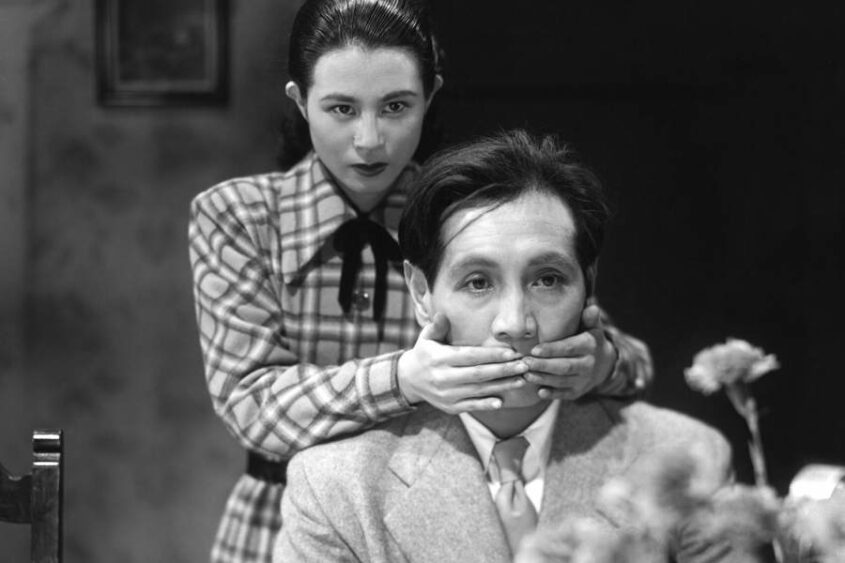
Akira Kurosawa’s The Idiot (1951) is a ruthless philosophical experiment disguised as a psychological drama. Transposing Dostoevsky’s novel from 19th-century St. Petersburg to post-war Hokkaido, Kurosawa uses his camera to magnify not just a character but a concept: absolute empathy. The film argues an unsettling thesis: that the world cannot, by its very nature, harbour sanctity. Purity of soul, it insists, survives only in the form of madness.
Based on Fyodor Dostoevsky’s eponymous 1869 novel, The Idiot turns 75 this year—and remains perhaps the most painful entry in Kurosawa’s filmography. His original cut ran 265 minutes, intended for release in two parts. Shochiku Studios deemed it too long and forced a reduction to 180 minutes for its premiere. That version screened once. The studio then cut it further, without consulting Kurosawa, to the 166-minute print that survives today.
The critical reception was merciless. Reviewers found it incoherent and difficult to follow. The verdict was more a reflection of what happens when nearly a hundred minutes of connective tissue are removed from a film, than criticism. Kurosawa was devastated and didn’t return to work with Shochiku again until Rhapsody in August (1991), 40 years later. When he did, he used the opportunity to search the studio’s archives for the original negative. He found nothing. The full cut has never been located. What remains is a film incomplete by force, not by design. (Reportedly, Andrei Tarkovsky was among those who recognised it for what it was).
Snow as the Blank Canvas of Existence
Something of that incompleteness seeps into the landscape itself. The endless snowstorm blanketing Hokkaido is less a geographical location than an ontological condition: an all-consuming white void that evokes the formlessness before creation and the formlessness that waits after it. Everything human beings construct—identity, desire, possession, love—is etched onto this whiteness temporarily, and erased.
It is worth noting that Kurosawa made this choice deliberately. Dostoevsky’s St. Petersburg was a city of social density, class friction, and competing ambitions. Hokkaido strips all of that away. What remains is a landscape that cannot pretend to care—and that indifference is the point.
The protagonist Kameda is born from this snow, and by the end of the film, retreats into a madness indistinguishable from it. He is a spirit emptied of self-interest, borders, and ego, unable to grasp constructs like property, envy, or contracts that define human society. He is an emissary of a reality the world consciously rejects.
Epilepsy as Gnostic Revelation
Kameda isn’t simply a good man. He is the incarnation of a radical, almost pathological empathy, one that absorbs the suffering of others as involuntarily as breathing. To the self-interested world around him, this reads as idiocy.
His epileptic seizures are more than medical affliction; they are moments of apocalyptic revelation. The sudden cut to a blinding sun followed by total darkness evokes a gnostic vision. An unbearable exposure to cosmic truth no mortal mind can handle. This light scorches Kameda’s soul, plunging him back into darkness. He sees the world in ways others cannot, and this clarity is his curse.
What makes this reading persuasive is the behaviour of the characters around him. No one attempts to understand Kameda. They attempt to possess him. Taeko projects her guilt-ridden need for salvation onto him. Ayako tries to rescue and normalise him. Akama views him as a rival to be destroyed. Each of them attempt to commodify and control his purity, destroying it in the process. Not out of malice, but because they cannot conceive of any relationship that does not involve appropriation. Kameda’s tragedy is not that he is misunderstood. It is that understanding him would require a quality of selflessness the film suggests the world structurally cannot produce.
Love as Consumption: Two Ruinous Poles
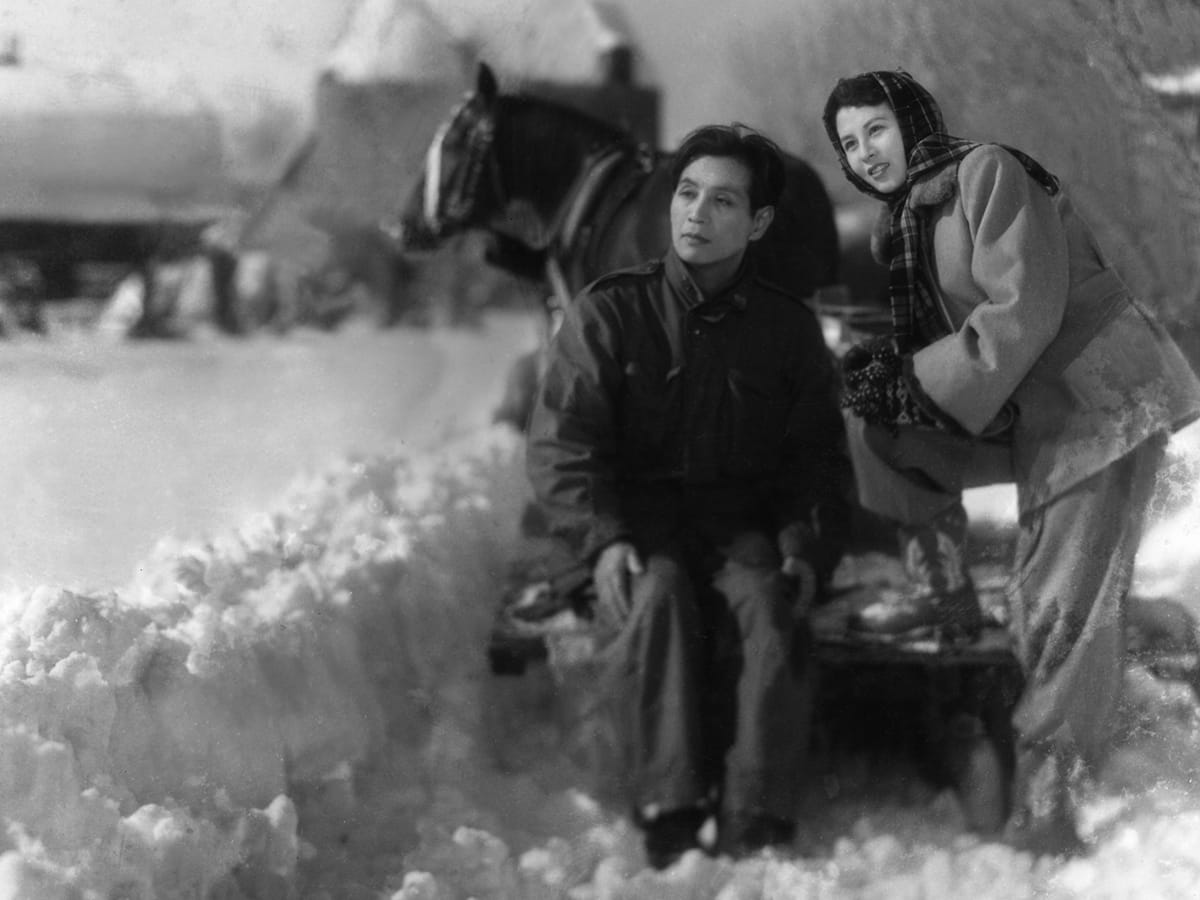
The two women in Kameda’s life embody contrasting yet equally destructive forms of love. Both are rooted not in acceptance, but in need.
Taeko , the fallen angel, burns with passionate self-destruction. She seeks his purity a tool for her own redemption, a love that demands sacrifice and drags them both toward ruin.
Ayako, representing bourgeois order, craves stability and possession. She is fascinated by Kameda’s strangeness but attempts to domesticate and rationalize it, blind to the fact that his essence is incompatible with her world. She’s not cruel. She is simply operating within a framework that has no category for what Kameda is.
Both women crucify him, and neither intends to. Their love demands control rather than acceptance. And Kameda, who is capable only of the latter, has nothing in his possession that either of them actually wants.
The Cinematic Language of Freezing and Silence
Kurosawa’s visual strategy throughout is one of deliberate, almost punishing restraint, and it is inseparable from the film’s argument.
The stark contrast between the vast, cold outdoor wilderness and the claustrophobic dark interiors is not decorative. It enacts the film’s central problem: there is no space in this world where Kameda can exist. The exterior is inhospitable; the interior suffocates. He belongs in neither, because neither was built for him.
Silence dominates the film. Long stretches without dialogue, punctuated only by wind and compacting snow. This is not atmosphere. It is the sound of characters failing to reach each other. The prolonged close-ups, faces held in frame far beyond the point of comfort, make visible the film’s most painful irony: they gaze at one another with tremendous intensity and still invisible to each other. The camera insists on proximity. The characters achieve none.
The Tragic Victory of Dissolution
By conventional standards, Kameda fails. He saves neither Taeko nor joins Ayako, retreating into absolute madness. But from Kurosawa’s and Dostoevsky’s perspective, The Idiot makes a more radical claim: that a life founded on absolute empathy is itself sacred. Even when, perhaps especially when, it ends in self-destruction.
The film’s final move is its most precise. Kameda’s madness is not defeat. It is the world’s verdict on itself. Proof not of his inadequacy but of the world’s inability to accommodate what he represents.
In the final frame, Ayako gazes out at the relentlessly falling snow. She is looking at the space where Kameda was, without knowing it. Human passion and suffering flicker briefly against an eternally indifferent cosmos. Beauty appeared, went unrecognised, and dissolved into the white silence. That is the film’s argument, stated not in dialogue but in weather.