
Some horrors belong to the past. They should stay buried, sealed beneath the sands of time. But what happens when they claw their way back, tearing through domestic calm and turning a home into a private hell? Lee Cronin’s take on The Mummy tries to answer that.
The past is past for a reason. F. Scott Fitzgerald said as much, and the point holds even in paraphrase. What’s gone should remain locked away, preserved in some distant, untouchable space, so we can keep moving forward. Because one question lingers, sharp and persistent: if something or someone could return, what form would it take? Would it be the same as before, or something new and deeply disturbing?
These ideas run through this new reboot of the 1932 horror classic. Time, here, is a shifting desert. Ancient curses stir. The evil at the centre feels unknowable, almost invincible. These are the foundations of Lee Cronin‘s The Mummy (2026), which resurrects one of the most iconic creatures from the Universal Classic Monsters cycle.
Back in 1932, producer Carl Laemmle Jr. became fascinated with ancient Egypt—specifically the legends surrounding the opening of Tutankhamun’s tomb, which had occurred only a decade earlier. Its echo was everywhere, feeding a global obsession with the Middle East and its mysteries that shaped pop culture and Hollywood alike (think Theda Bara’s anagram, “Arab Death”).
Laemmle tasked story editor Richard Schayer with finding a novel that could serve as the basis for an Egypt-set horror story. The search led nowhere. Instead, together with writer Nina Wilcox Putnam, Schayer drew on the legend of the infamous occultist Count Alessandro di Cagliostro and wrote a nine-page outline titled Cagliostro. The starting point was a character who had survived for thousands of years, making his way to 1930s San Francisco sustained by nitrate injections. That idea was eventually reshaped into an Egypt-set screenplay, with credited writer John L. Balderston brought on board. Balderston had covered the opening of Tutankhamun’s tomb firsthand as a correspondent for the New York World, and his experience helped ground the film’s exotic mystique. This is how Universal’s The Mummy was born, expanding a monster roster that already included Dracula (1931) and Frankenstein (1931) with a new, enduring nightmare.
But what did this ancient undead figure really represent? A creature rising from the Egyptian underworld, wrapped in sand and driven by lost love, speaks to a deeper fear: the past as something that cannot be reclaimed. Or worse, something that returns in a warped, monstrous form. By blending historical echoes with pure invention, Karl Freund’s The Mummy (1932) taps into a familiar but potent archetype—the fatal illusion of impossible love. The desire to resurrect what is gone becomes a death sentence for its protagonist, played with eerie restraint by Boris Karloff.
Jump ahead several decades and the tone shifts dramatically. The 1990s usher in a more flamboyant, adventure-driven take, one that leans heavily into spectacle and humour. The 1999 film reimagines the property as a kinetic action franchise, spawning sequels and spin-offs while reshaping the monster into something more accessible, less uncanny. For over thirty years, Universal tried to modernise its classic creatures with mixed results. The 2017 reboot ended up as a disjointed blockbuster, caught between tones and stripped of identity. Even Tom Cruise couldn’t hold it together.
That changes with the success of Evil Dead Rise, which puts Lee Cronin firmly on the map. Both writer and director, Cronin has a strong taste for genre tradition. His work is steeped in references, yet rarely feels derivative. He understands how to recycle familiar elements without flattening them into cliché. Not an easy balance, especially in a horror landscape that constantly shifts between graphic violence, stylized aesthetics, and social commentary.
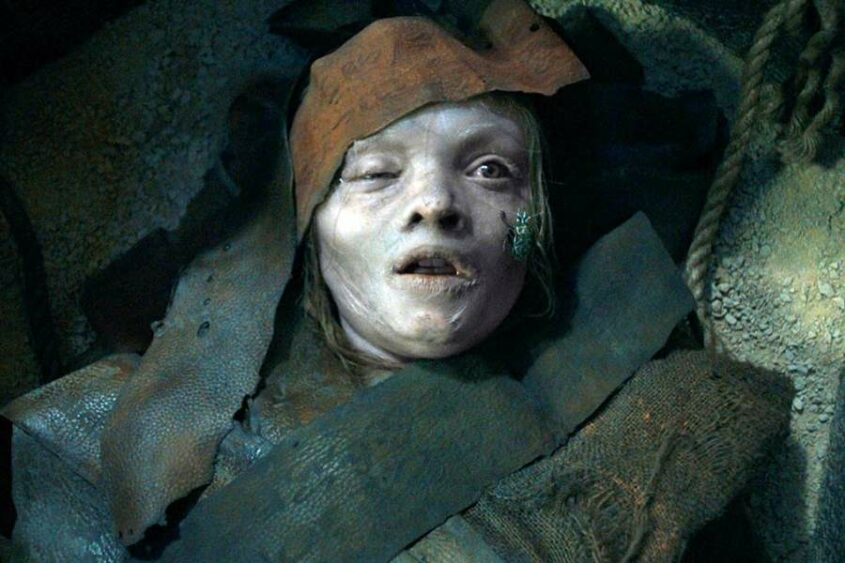
To bring The Mummy into the present, Cronin starts with a blunt, effective hook: a disappearance. The young daughter of a journalist vanishes without a trace. The family is living in Cairo, where the father works as a TV correspondent alongside his pregnant wife and their son. Eight years later, still fractured by grief, they are shaken by the sudden return of the missing girl, now a deeply traumatised teenager. What should be a moment of relief curdles quickly into something else. The reunion does not heal the wound. It tears it wider, turning the family’s life into a waking nightmare.
Starring Jack Reynor, Laia Costa, May Calamawy, and Natalie Grace, with Veronica Falcón in a supporting role, the film is produced by James Wan, Jason Blum, and John Keville through Atomic Monster and Blumhouse. From the outset, the project signals a more author-driven approach. This is not another market-friendly remake built to cash in on a familiar title. Cronin steps in as a filmmaker who understands the genre. He knows how to shape it, even when the script shows its cracks.
Those cracks become visible in the film’s structure. The imbalance between acts is hard to ignore. The third act leans heavily into excess, embracing a chaotic, overtly Hollywood mode that favours spectacle over tension. The gore and splatter leaves little room for suggestion, flattening the more unsettling edges built carefully in the first two acts. Horror, after all, thrives on what it withholds. When fear is implied rather than shown, the imagination does the real work. By contrast, the first two acts are far more controlled. They build a steady, oppressive escalation, blending grotesque imagery with emotional unease. Here, Cronin’s visual instincts come through with clarity.
The screenplay draws a clear line between theme and subject. It knows what it is about and what it wants to say. Time sits at the centre, not as nostalgia, but as something irretrievable. The past cannot return unless it mutates into something alien. Alongside this runs a second axis: the family. What begins as a space of protection slowly turns hostile, then unrecognisable. The home becomes a battleground. The ancient force at the heart of the film thrives on division, pushing parents and children toward mutual destruction. Cronin taps into a lineage of possession and haunted-house narratives, echoing familiar patterns without fully collapsing into imitation.
Visually, the film draws from a dense range of influences. There is the grotesque physicality of Raimi, alongside a more spiritual tension that recalls possession cinema at its most severe (with Friedkin’s The Exorcist as a big reference). The clash between the sacred and the profane runs throughout, framing horror as both bodily and metaphysical. Reinventing a legacy franchise through pure originality may be an illusion at this stage of cinema. Contemporary horror often works through recombination, reshaping existing forms into something that feels immediate. In that sense, Cronin’s film operates like a dense collage, pulling from the past while trying, not always successfully, to carve out its own identity.
Lee Cronin doesn’t reject the past. He negotiates with it. His approach reshapes contemporary horror through a personal lens, returning the fault lines of the family to the centre of the frame. The house is no longer a shelter. It becomes a container for buried tensions, a space where the unspeakable takes form. Working firmly within genre conventions, Cronin leans into body horror—not just for shock, but to make visible what is otherwise invisible. Illness, decay, psychological fracture. The horror here is physical, but it cuts deeper, spreading across the entire family unit.
In the end, Lee Cronin’s The Mummy stands as a smart, distinctly modern reworking of a well-worn myth. It stays rooted in tradition while finding ways to refresh it, preserving the weight of Universal’s monster archetypes without turning them into relics. Cronin injects them with new unease, framing the story as an ongoing dialogue between past and present, fear and fascination, dread and dark pleasure. The result does not reinvent the rules, but it reshuffles the deck with intent, drawing from the strongest cards horror still has to offer.