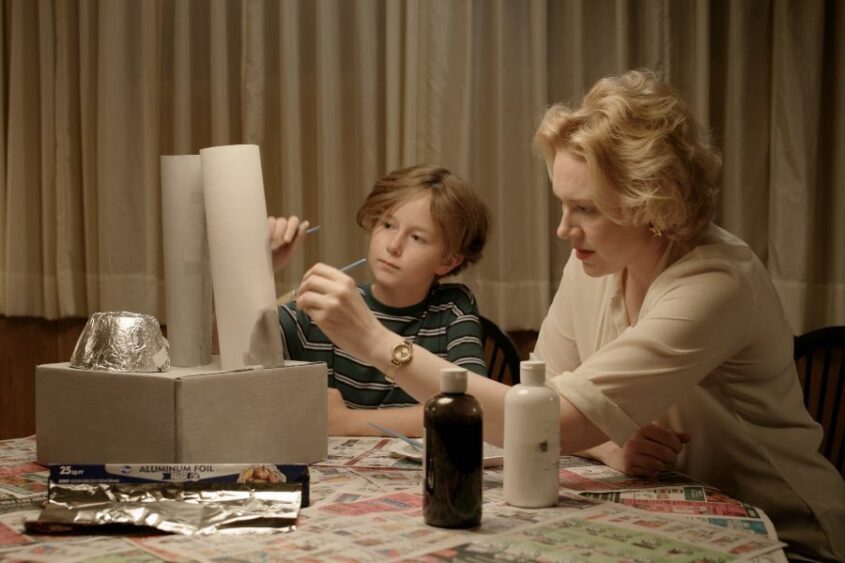
It’s 1989. There’s no Zoom, no ChatGPT, no last-minute lifeline available at the touch of a screen. When Jason (Espyn Doughty) leaves a major homework assignment until the night before it is due, his single mother (Charity Schubert) is forced into an overnight scramble to help him through it. ‘Last Minute’ won the Grand Prize at the Louisiana Film Prize before earning its Tribeca Festival premiere on June 6, 2026 and it justifies both. At eight minutes, it’s more than a nostalgic comedy. It’s a remarkable lesson in how much a short film can carry when pacing, emotional stakes, and character are working in the same direction.
Flickside spoke with writer-director Michael Cusumano and Schubert, who also executive-produced the short. They discuss why the film ultimately became stronger once they stopped prioritising speed and focused instead on character and what it actually takes to act and produce simultaneously on a tight schedule. For emerging filmmakers, it’s a candid conversation about shaping a short that feels emotionally grounded and festival-ready from the first cut.
You’ve spoken about realising your childhood memories were starting to feel historical. At what point did that realisation become a filmable idea, and what did you discard before settling on the last-minute homework scenario?
Michael Cusumano: The idea started with snow days. I learned from my nephews that, because of remote learning introduced during COVID, schools no longer really need to give kids a day off. That got me thinking about all the things from my childhood that would seem alien now.
As a chronic procrastinator, my mind immediately went into the panic of finishing a homework assignment the night before it was due without the help of the internet. Once the scene ideas started coming quickly, I knew there was a film there.
Short films often live or die by their constraints. What were the rules you set for yourself going into the script, and which ones did you end up breaking, and why?
MC: I wanted everything to feel believable. The premise could easily have slipped into broad sitcom-style comedy, but I wanted the humour to come from the details and relationships.
Originally, the film was entirely from Jason’s perspective, but Jackie gradually became the emotional centre of the story. Her conflict was more interesting because she is not only trying to help her son finish the assignment, but also questioning whether rescuing him is rewarding bad habits.
The film is set before the internet, which removes the easiest dramatic escape route available to modern characters. How did you research the period detail, and how did you use the absence of technology as a dramatic tool rather than just a setting choice?
MC: Charity and I spent months researching the late 1980s. We wanted the details to feel authentic without overwhelming the story. The goal was for audiences to believe the period and then stop noticing it.
The absence of technology was built into the premise from the beginning. Without the internet, the characters are forced to leave their bubble and interact with other people. That tension became central to the film.
How early did your cinematographer come into the process, and how much of the film’s visual language was established in prep versus discovered on the day?
MC: My cinematographer, Rob Senska and I fell into a great rhythm shooting my first short, so I was eager to get him on Last Minute from the very beginning. In addition to being great at his job, he is also an invaluable barometer for my own ideas. If I can make Rob see what I want, I know I have a clear vision.
The film was simply too ambitious (something like 24 scenes in 3 days) to wing it, so we did as much work as possible before filming to figure out the film’s visual language. I sent him an annotated version of the script describing how I wanted scenes to feel – the atmosphere, the emotions – along with specific shot choices, and he responded with the practicalities of what achieving that would require.
There was also the concern of visual monotony with a big percentage of the movie happening in one living room, so there was discussion about giving every scene its own distinct visual personality.
All the prep paid off because, due to location problems, we weren’t able to have any time on the actual set until shooting, so we certainly didn’t have time to explore the space, experimenting with angles, we had to go. With his experience shooting reality TV, Rob is phenomenal when it comes to finding strong choices quickly.
Short films are often fundamentally rewritten in the edit. Was there a scene or sequence that only found its shape in post – something that surprised you about how it came together?
MC: Absolutely. One thing I learned was how little exposition you actually need. I originally imagined a much longer opening sequence building Jason’s panic, but in the edit, we realised the audience understood the situation immediately.
A single moment of our young actor squirming at a blank page communicated more than an entire page of explanation.
With a short film, every scene you cut from the script is a decision about what the film actually is. Was there anything substantial you removed?
MC: The original script used a flashback structure. It began with Jason presenting the assignment in class, then cutting back to the previous night to show how each section came together.
It ended up feeling too fragmented. Once you were with Jackie and Jason, you did not want to leave them. Removing the framing device gave the characters more room to breathe and preserved the suspense.
Was there a day on set where the film you were making stopped resembling the film you’d planned, and how did you respond to that in the moment?
MC: In some ways, yes. I originally imagined the film moving at an almost relentless pace, with scenes lasting only seconds.
But while editing, I realised I was more interested in lingering on quiet character moments. My editor pointed out that those pauses were where my voice as a filmmaker emerged. Slowing down allowed the emotional side of the story to come through.
Charity Schubert joined the conversation. A New York-based actor, she has worked across stage and screen in the city and the wider region. Last Minute marks her second collaboration with Cusumano, following Napoleonic Code.
How did you approach your character, Jackie, and build one that reads as fully formed in a runtime that gives you almost no time to establish her outside of the crisis?
CS: Jackie became clear to me through her relationship with Jason. Michael did not write a traditional mother-son dynamic. She speaks to him almost like a small adult, which makes sense because she is a single mother carrying both parental roles.
That dynamic helped me connect with her quickly and understand how exhausted and overwhelmed she is.
The mother-son dynamic has to carry significant emotional weight in a very short runtime. Was there a specific rehearsal moment or on-set decision that made that relationship feel real rather than functional?
CS: We rehearsed with Espyn [Dought] over Zoom before filming, which helped us establish the rhythm between Jackie and Jason.
We also spent time together off the set before shooting began, and by the time we filmed, there was already a natural rapport. Espyn is incredibly easy to work with, so the warmth between the characters came very naturally.
The film has a constant sense of urgency. How did you keep that feeling fresh across multiple takes?
CS: I always focused on the stakes Jackie was facing. Her son failing the assignment reflects on her as a parent, and she feels responsible for fixing the situation. That anxiety kept the performance moving forward.
How did you balance acting with producing?
CS: I wore multiple hats on the film, including wardrobe and props, so preparation became essential. I tried to handle as much producing work as possible before stepping in front of the camera.
Oddly enough, the stress of producing actually helped the performance. Jackie is exhausted, overwhelmed and constantly solving problems, which feels very close to the experience of making a short film.
At one point, our picture car fell through and Michael had to rewrite a scene. Then we were shooting an exterior scene while a train disrupted the sound, and the sun was setting. At that moment, Jackie’s frustration required very little acting.
Acting and producing require fundamentally different modes of attention. How did you manage the shift and was there a moment where the two roles genuinely pulled in opposite directions?
CS: Definitely. The costume, hair and makeup transformed how I saw Jackie. Once I put on the wardrobe and saw the late-1980s styling in the mirror, I immediately understood her more clearly.
There is a brief moment where Jackie comes home exhausted from work, and the physical transformation helped ground that scene emotionally.
You and Michael have worked together before. How does an existing creative relationship change the dynamic on set? Does familiarity make the work harder rather than easier?
CS: Michael and I previously worked together on Napoleonic Code, so I already trusted him as a director.
That trust lets me fully commit to the performance because I know he will push me when necessary. He holds me to a very high standard without making me feel unsupported, which is invaluable as an actor.
What advice would you give actors producing their own projects?
CS: Producing will constantly compete for your attention, so you need to actively protect your performance. There will always be another problem to solve, but you still need time to rehearse, memorise lines and prepare emotionally.
I also think actors often try to do too much themselves. It is expensive, but hiring professionals wherever possible makes a huge difference. Strong sound, lighting and production design matter just as much as the performance.
Executive producing a short film is often less about creative decisions and more about creating the right conditions for everyone else to do their best work. What does that actually look like in practice on a short, with a tight schedule and limited resources?
CS: For me, it mostly meant making sure the cast and crew felt supported. On an independent production with limited resources, you cannot offer luxury, but you can create an environment where people feel respected and appreciated.
Keeping morale steady during stressful moments is an important part of the job.
In the final question, both Cusumano and Schubert affirm why a story rooted in 1989 still feels strikingly relevant today.
If this story were made today, what would replace the pre-Internet panic?
Kids still leave homework until the last minute, so that part would not change. But we would still want the story to force Jason away from technology and into real interactions with people.
The core idea of the film is that technology can isolate us. That theme still feels relevant, even if the tools have changed.
Last Minute screens at the 2026 Tribeca Festival in the Care Package short films block, on June 6. The festival will take place from June 3-14 in New York City.