The BAFTA-qualified filmmaker on character construction, practical production challenges, and making I Am The Prize on a two-day schedule
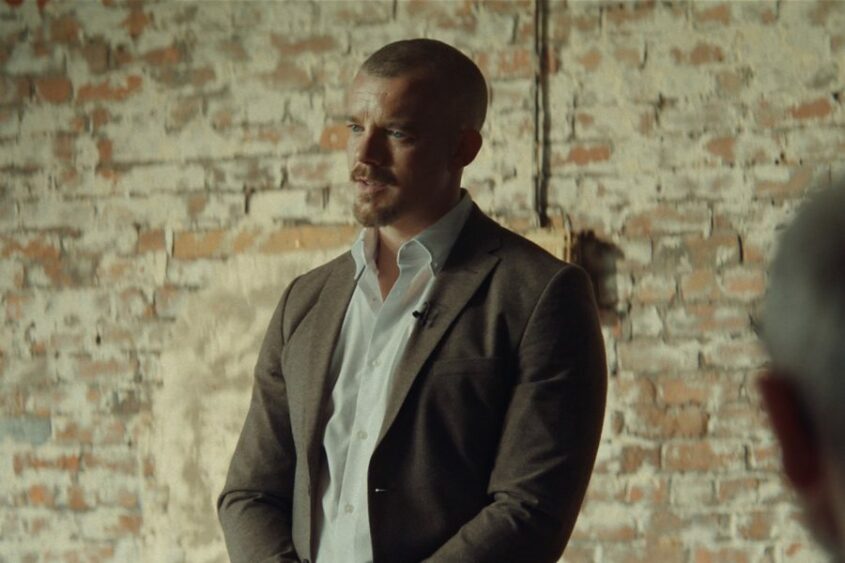
Sai Karan Talwar’s third short film stars Russell Tovey as Anthony—a charismatic, polarising self-help figure whose appeal is as unsettling as his worldview. Rather than simply condemning him, Talwar examines what sits underneath: the self-mythologising, the insecurity, the performative power. It is a more psychologically demanding approach than most films on this subject attempt.
Talwar’s short film debut Ghanimah (2022) was BAFTA and BIFA qualified and screened at over sixty festivals. His second short, a 15-minute single-take What Men Do For Love (2024) was longlisted for the Academy Award in 2026. I Am The Prize is currently screening at Frameline and Raindance.
For filmmakers earlier in their careers, the conversation that follows is worth paying close attention to. Talwar speaks with unusual candour about character construction, visual strategy, and the practical decisions behind making ambitious short films on limited resources, the kind of detail that rarely makes it into interviews. We spoke to him about influence, performance, and why understanding a figure like Anthony matters more than dismissing him.
Your film is about a man who has fully bought into a very particular idea of what it means to be a ‘man.’ And it arrives at a moment when this conversation is everywhere. It’s a well-trodden subject. But what struck me about your film is the angle you chose, because Anthony, played by Russell Tovey, is reprehensible, yes, but also genuinely complicated. What did you feel you could bring to this conversation that hadn’t already been said?
The key thing is that this character has been around in my mind for a long time. Anthony exists within a larger story I wrote during the BBC Writers’ Room programme, where I was developing a pilot over about a year and a half. He was one of several intersecting characters in that world. That script had originally been a feature, then became a pilot, and later I went back to the feature and reworked it into something tighter.
So Anthony has been in gestation since around 2020 or 2021, when figures like Jordan Peterson were already visible and Andrew Tate was just beginning to emerge. Since then, that whole culture has evolved, and I wanted to make sure the character stayed current with what was happening in real time.
What interested me was that we’ve often seen people influenced by these figures, younger men acting on those ideas, but we haven’t spent enough time looking directly at the source. Who are these men? Why do they do this? What leads them to become the kind of people others follow?
If you tackle the issue at its root, there’s a chance to show that these men are just conmen, and that they don’t deserve the power they’ve been given. I think we’ve seen the effect of the ideology, and now we’re starting to look at the cause. The next step, hopefully, is that we’ll start seeing more stories about the victims of that culture too.
That leads well into my next question: where did Anthony come from? How did you develop him as a character?
He really came out of graduating around 2020 and watching these figures become more visible. At first, it was the Jordan Peterson types, then the Andrew Tates, then a whole wave of similar people after that.
Initially, it all felt niche. You’d have friends recommending them, saying, “These guys are really interesting – you should check them out.” Then the more you looked into it, the more you realised how twisted and morally bankrupt it all was. The ideology underneath it was deeply unsettling.
From there, it expanded into something bigger. Historically, if you look at the archetype of the conman, there’s always a kind of snake-oil salesmanship involved. That’s what interested me most. These people may change form – snake-oil salesman, cult leader, social media influencer – but the core psychology doesn’t really change. They just adapt to whatever environment they happen to exist in.
When I was thinking about Anthony, I was drawing on figures like L. Ron Hubbard and Roy Cohn as much as contemporary influencers. He’s a kind of combination of those histories and these modern personalities. What unites them is the way they twist truth to fit their own framework and maximise their own success. That, to me, is the enduring shape of the conman. Anthony is really a contemporary version of that archetype.
What was it like working with Russell Tovey on this project? He’s someone many viewers will know from Doctor Who, Gavin & Stacey and so much else. What was it like collaborating with him on such a stark and serious subject?
My earliest awareness of Russell was from things I watched when I was younger, but my real appreciation of him as an actor came later, especially with Angels in America and The Pass. In both, he was playing characters dealing with s**uality, repression and identity in really nuanced ways.
That felt important, because Roy Cohn was one of the influences on Anthony, and Russell had already played Joe Pitt in Angels in America, who sits in the orbit of that world. It just felt like a natural progression for him, as an actor at this stage in his career, to take on someone like Anthony.
He had also recently done Plainclothes, so there was already a visible trajectory in the kinds of roles he was exploring. He understands these characters. He’s spent time with their contradictions, their repression, their confusion. That meant we didn’t need much rehearsal. We had an initial conversation, he was in, we made a few minor revisions to the script, and by the time we got to set he already knew who this man was.
That’s the ideal kind of collaboration. I trusted that he understood the character deeply, and he did.
Talk us through the opening prologue, because it’s a real eye-opener. The concept and execution of filming that scene – essentially a slow, tightening one-shot as Anthony addresses his audience – is striking.
That scene had to convince the audience of who Anthony is. We couldn’t just show a snippet of what he does and then move on to the consequences. You need to understand how he commands a room, how he gets attention, how he wins validation, because without that the rest of the film doesn’t fully land.
At the end of the day, there is something magnetic about people like him. There’s confidence, there’s control, there’s performance. So, the scene had to let us experience that in real time. The unbroken take was important because he is in command of that moment. The camera slowly moves in because he’s pulling you towards him. He’s reeling you in.
At the same time, if you really listen to what he’s saying, so much of it is nonsense. That’s what fascinated me. It’s the way conmen operate. They build these elaborate, pseudo-intellectual frameworks that sound convincing because they deliver them with total certainty. The more confident they are, the more people lean in, even when the ideas themselves don’t hold up at all.
That was very much part of the intention. We needed to watch him at work and believe, at least for a moment, that he has the influence the film says he has.
A major reference for me was the opening of Patton (1970). That speech was absolutely in my head while writing and staging the sequence. Whatever you think of Patton as a figure, that opening tells you exactly who he is, what he believes, and what kind of film you’re entering. I wanted that same sense of ideological introduction – only here it becomes something far more toxic and hollower.
As it’s a short film, there are obvious constraints on runtime and structure. Did you have to let go of anything from the original plan?
Yes, definitely. A lot of that came down to the fact that we shot the film in two days, which is a very tight schedule.
There was a sequence after Anthony collapses where he was in an ambulance. It would have added production value and extended the aftermath of that moment, but there simply wasn’t time. We also had to lose other smaller linking material, like scenes of him moving around the hotel after the exposure and interview.
When you’re working in that kind of timeframe, you have to become very practical. We shot the opening s** scene and the hospital material on the first day, then the seminar scene and the interview material on day two. It was all planned carefully, but things still have to go.
In the end, the cuts helped. Those scenes would have functioned more as transitions or inserts than as essential dramatic beats. The film still has its impact without them, and in some ways it becomes tighter for that reason.
If it had been a feature, would those scenes have stayed in? And are you fully content with the short-film format?
The feature version is an ensemble drama, so this short only gives you one part of Anthony’s wider story. In the feature, he’s one character within a family story, and he’s the estranged brother of one of the other major characters.
So what you’re seeing here is really only half of his arc. There’s another section beyond this where everything begins to fall apart and he has to confront the fact that he may lose everything. That becomes the second half of his story – not just the exposure, but what happens when he has to face himself.
What mattered with the short was that it had to work on its own terms. I couldn’t just extract any of the other characters, because their stories wouldn’t have held in the same way over this kind of runtime. Anthony was the one character whose material could be shaped into a self-contained film while still feeling complete.
That, and the fact that he felt especially topical, made him the obvious choice.
There’s a key interview scene in the film where Anthony is finally put under pressure about his backstory and previous comments. How did you approach that sequence? Was it important not to make it simply an attack on this culture?
That scene had to happen, because it’s the catharsis. You spend so much of the film watching this man behave terribly that at some point he needs to be held accountable. The audience is waiting for it.
I’m not interested in passing simplistic judgement. I don’t like the character, and I don’t think anyone else likes him either, but the goal is to understand him. If you understand him, then you can start to understand the roots of the problem. But understanding him doesn’t mean excusing him.
That interview is where his power starts to collapse. He comes in thinking he knows the format, the questions, the talking points. He thinks he can perform his way through it like he always does. Then suddenly he realises she has information he wasn’t prepared for. Once that happens, he can’t control the situation any more.
By that point, his health is already strained, he’s exhausted, and the facade is beginning to crack. He doesn’t know whether to deny, deflect or confess, because he knows this could destroy him. That’s what makes the scene satisfying. He can’t keep the mask on indefinitely.
For film students and aspiring filmmakers, were there any major production difficulties while shooting?
We largely got the film the way we wanted it, but there were definitely challenges.
One of the biggest practical ones was filling the room for the opening seminar scene. We needed enough extras to make that environment feel credible. In the end we got around 50 or 60 people, which was enough to give the room the right sense of scale and authority.
The hardest sequence, though, was probably the interview scene – partly because of the weather and partly because of two seagulls on the roof. There was a rainstorm during shooting, and the microphones were sensitive enough to pick up everything. So we’d wait for the rain to stop, get ready to go again, and then the seagulls would start up. Then we’d stop, reset, wait, and try again.
That became the rhythm of the afternoon: wait for the rain to stop, wait for the birds to stop, then shoot. It was frustrating, but we still managed to get what we needed. Those are the things you can’t plan for, and you just have to keep adapting.
The film is screening at Raindance and Frameline – two very different but important festivals. How do you feel about it being received in different contexts?
I think that’s exciting. I want the film to reach as many people as possible, but also the right kinds of audiences for the themes it’s exploring.
The queer dimension of the story is deeply tied to Anthony’s repression and self-hatred. He’s someone who has buried an essential part of himself and chosen instead to pursue validation, power and control. That validation becomes addictive. It gives him a sense of authority, but at the cost of his authenticity.
In that sense, one of the underlying ideas in the film is that his refusal to be honest with himself is part of what destroys him. He’s turned himself into someone monstrous because he can’t live truthfully. I think that can resonate strongly with queer audiences, especially in a festival context like Frameline.
At the same time, the film is doing several things at once, and those themes are all interconnected. Raindance offers a broader independent film audience, whereas Frameline brings a more specific lens. I like that the film can live in both spaces.
Talking of authenticity: Russell Tovey is gay in real life. Was that important to you? Did it affect how you approached the role?
Yes, it mattered. I wanted someone who would understand the character as fully as possible, and Russell was the best person for that role.
A lot of that came from seeing the kinds of characters he had already played, especially in Angels in America and The Pass. There’s an authenticity and rawness in his performances that made me feel he would be ideal for Anthony. He has a very natural quality on screen. It never feels like he’s pushing. Even the smallest facial shifts or micro-expressions feel lived rather than performed.
That kind of naturalism is rare. Some actors just have it. There’s a spark there, and with Russell I think that’s very true. So yes, if you have a gay character, ideally you want a gay actor playing the role – but above all, you want the best person for the role. In this case, that was Russell.
Finally, what advice would you give to film students and aspiring filmmakers trying to get their work into festivals?
The main thing is: find a way to make things work, and don’t wait around endlessly.
If you are going to wait, make sure you know that the thing is genuinely going to happen. Otherwise, you can lose years just sitting on an idea. My first film was basically three guys in a room shouting at each other, because that was what we could afford. My second was essentially two guys in a warehouse and a one-shot structure. That was what was possible at the time.
Those early films are where you learn. The first one teaches you how a set works and how to direct actors and collaborate. The second gives you more confidence, and maybe you try something more formally ambitious. Then eventually you get to a point where you stop experimenting for its own sake and start making choices based on what best serves the story.
That confidence only comes through doing the work. You keep making things, and over time you improve. Then, naturally, more opportunities start to open up: more money, better locations, stronger collaborators, more experienced actors. But none of that happens unless you keep going and keep finding ways to make the next film.