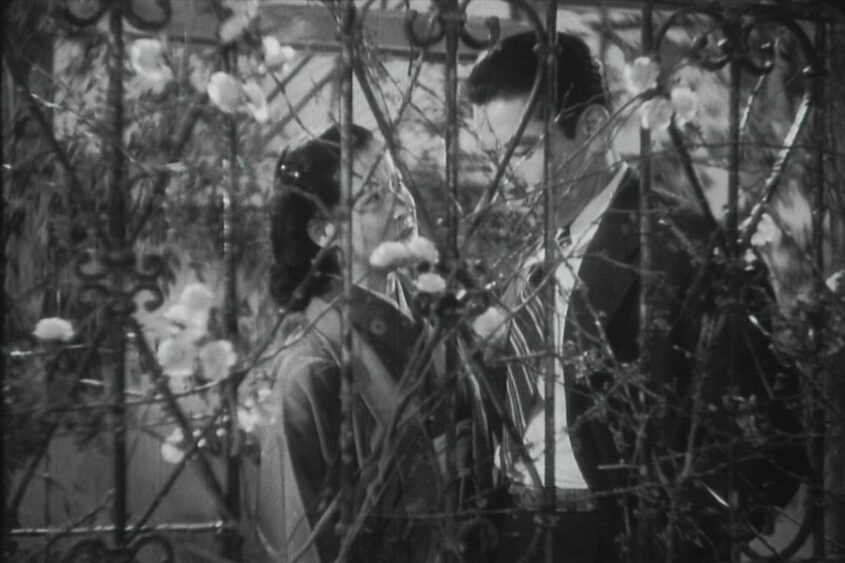
There is a moment early in The Quiet Duel (1949) where Toshiro Mifune, scalpel in hand, realises what has happened. A small cut. A contaminated instrument. A syphilitic patient bleeding on the operating table during the chaos of wartime surgery. The camera doesn’t linger. Kurosawa doesn’t underline it with music or a dramatic close-up. He lets the moment pass. The Quiet Duel explores how a man responds to his circumstances, rather than the events themselves. If Drunken Angel (1948) was an enraged scream directed at a diseased society, The Quiet Duel is an internal monologue. A lament from the recesses of a tormented soul.
A year after depicting Dr. Sanada’s boisterous battle with the external world, Akira Kurosawa turns his camera inward to witness a more terrifying confrontation: one man’s war against his own body and the crushing weight of a secret.
The Quiet Duel is based on Kazuo Kikuta’s stage play, and the theatrical origin shows. The confined, pressurised world of the clinic, the handful of characters, the absence of physical spectacle. All of it forces the drama inward, where Kurosawa is most interested in being. It’s a film about conscience as a burden, about sacrifice as a daily practice rather than a single heroic act, about what it costs a good man to remain good when the world neither knows nor rewards it. It is also, in ways that film history has not always acknowledged, one of Mifune’s two or three finest performances. And arguably an underrated Kurosawa film.
The Primal Wound: The ‘Fall’ from Paradise
Dr. Kyoji Fujisaki (Toshiro Mifune) is a young, idealistic surgeon performing emergency surgery in the final days of the second World War. He cuts his finger on a scalpel contaminated with the blood of a syphilitic patient, Susumu Nakada (Norio Sasaki). The wound is minor. The consequence isn’t. This moment is his ‘fall’.
In an instant, Fujisaki is exiled from the life he had imagined—a loving fiancée named Misao (Miki Sanjo), a future built on hope and vocation—into a private, hidden hell. He cannot tell Misao. He cannot marry her. He cannot explain. He can only disappear behind a mask of cold indifference and hope that she eventually stops asking why.
Syphilis in this film carries a very different symbolic weight from the tuberculosis in Drunken Angel. TB was Kurosawa’s metaphor for social corruption. A disease that spread through communities, through the fabric of postwar Japan itself. Syphilis here is something more intimate and more damning. It’s a stigma, a mark of shame, a disease so entangled with moral and sexual taboo that to admit it publicly would be to court social destruction. The distinction matters enormously. In Drunken Angel, the disease is an accusation directed at society. In The Quiet Duel, it is a sentence handed down to a man for a crime he didn’t commit.
This is where Kurosawa’s script, adapted with Senkichi Taniguchi from Kikuta’s play, is most precise. Fujisaki is not punished for vice. He is punished for virtue. For showing up, for operating, for doing his duty as a physician in a war that had already taken everything from everyone.
The Silent Duel
The film’s title brilliantly captures the dual nature of Fujisaki’s struggle.
The first is with the disease. This is his external, scientific battle. Fujisaki treats himself with Salvarsan injections (the standard syphilis treatment of the era, painful and slow); he is symbolically flagellating himself for a sin he did not commit. These scenes are staged with clinical austerity. There’s no music, no dramatic lighting, Fujisaki alone with a needle in hand. The staging is instructive. Kurosawa understands that restraint in how a scene is shot can communicate moral weight more powerfully than any amount of visual emphasis.
The second battle is internal and far more devastating. To protect the one person he loves, Misao, Fujisaki is forced to lie and reject her. He calls off their engagement under false pretense, hiding behind coldness and indifference. Every innocent, loving glance from Misao eats away at his guilt. To remain “good,” he must appear “bad.” To prove his love, he must deny it. This tragic paradox is the core of the film.
Characters as Mirrors
Kurosawa has always used supporting characters as moral counterweights to his protagonists. Characters whose choices illuminate, by contrast, the road the central character has taken. He does the same in The Quiet Duel.
Susumu Nakada (Norio Sasaki), the soldier whose contaminated blood set everything in motion, is Fujisaki’s shadow self: the man Fujisaki could have become had he chosen differently. Nakada has denied his illness, impregnated his wife, infected her, and continued living like none of it were his concern. He is not a “villain” in a theatrical sense. He is a man of ordinary moral weakness.
When Fujisaki confronts Nakada, the scene crackles with an anger that is only partly about the man in front of him. It is also rage at fate. At the arbitrariness of a universe that has condemned a conscientious man and let a careless one walk free. Kurosawa stages the encounter in the cramped confines of the clinic. There’s no escape, no distance, no relief.
Minegishi (Noriko Sengoku), who discovers Fujisaki’s secret, is his only confessor. A former nursing trainee with her own troubled past, she alone understands the scale of what he is carrying. Two people, marked by circumstances beyond their control, find in each other a brief respite from the performance of normalcy. She does not pity him. That is precisely why the scenes work.
Toshiro Mifune’s Performance
Any serious reckoning with The Quiet Duel must grapple with what Mifune does here. And how radically it differs from the role that had made him, just one year earlier, a major presence in Japanese cinema.
In Drunken Angel, Mifune played a tuberculotic gangster with an almost frightening physical intensity: a performance that felt barely contained by the frame. In The Quiet Duel, that energy has nowhere to go. The character’s circumstances demand its suppression. And so Mifune suppresses it, which turns out to be more unnerving than releasing it.
The performance is built from the inside out. The tremor in his hands during the self-injections. The way he positions his body in scenes with Misao, angled slightly away, as if proximity itself is a danger. The moment, buried deep in the second half, where the mask slips for just an instant and the grief behind it floods the frame before he locks it down again. Mifune understood that the most powerful thing he could do in this role was to let the audience sense the pressure of everything being held back.
It is, by any measure, a great tragic performance and tends to be overlooked because it lacks the kinetic spectacle of his more celebrated work. For actors and directors, it is essential viewing. It is a masterclass in economy, in the physical grammar of acting, in the difference between acting pain and inhabiting it.
Sanctity in Isolation
The film ends with the only honest ending available to it. Fujisaki has not won his duel. He has simply decided to keep fighting it, alone, indefinitely. In this, Kurosawa reaches for something that runs beneath much of his early work. A Buddhist moral logic in which the highest virtue is action without reward, sacrifice without witness, goodness practiced in the absence of any audience. Fujisaki doesn’t renounce happiness in one dramatic gesture. He renounces it every morning when he comes back to work.
The Bodhisattva reading isn’t a stretch here. But what keeps the film from tipping into hagiography is Mifune. The cost is always visible in his face, even when the character is working hardest to hide it. This isn’t a saint at peace with his sacrifice. It’s a man who has chosen the harder thing and is still paying for it, daily.
The film poses one question and answers it in form rather than dialogue: does a sacrifice that goes unseen still have value? The quietness itself is the argument. The restraint at every level: in the staging, in Mifune’s performance, in Kurosawa’s refusal to sentimentalise any of it, is Kurosawa’s answer. Yes. The value is in the act. It doesn’t require an audience.
The Quiet Duel is one of Kurosawa’s least discussed films and one of his most morally serious. What it offers, if you meet it on its own terms, is something rarer than spectacle. Kurosawa made bigger films. He never made a more honest one.