What happens when your location is a real self-driving car, your camera is an ARRI Alexa 35, and you have to return the vehicle without a scratch? Independent filmmakers Kyle Valle and Erin Áine found out making ‘Autonomous,’ a vertical horror series of 16 sixty-second episodes that unfold as one continuous story, shot almost entirely inside a real autonomous vehicle. It follows a couple whose rideshare home spirals into a claustrophobic nightmare when the car begins taking them somewhere it shouldn’t. The constraint shaped every creative decision they made, and makes for an instructive conversation about low-budget filmmaking in spatially limiting conditions.
For readers discovering Autonomous for the first time, can you tell us what the series is about and what appealed to you about telling the story in this format?
Erin: Autonomous is a vertically shot micro-horror series made up of 16 episodes, totalling around 28 minutes, all designed to be binge-watched on your phone.
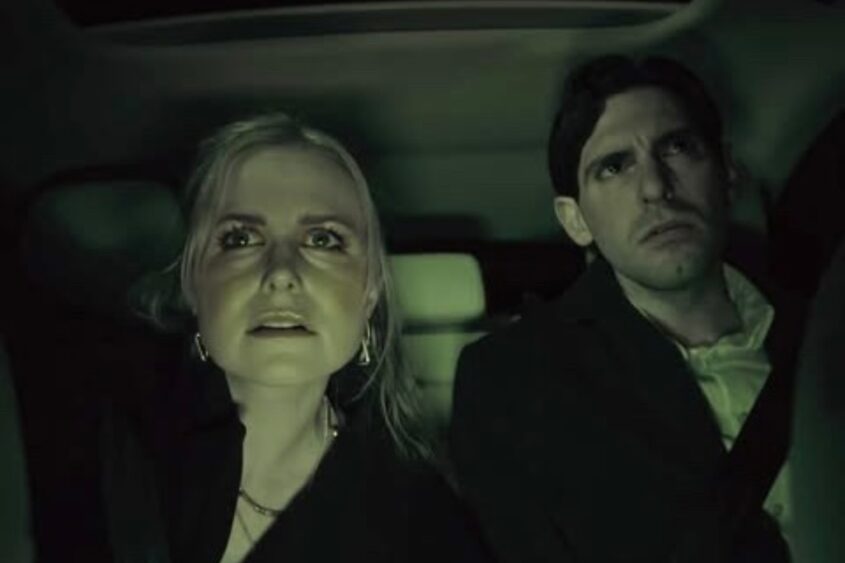
It follows a couple leaving a fancy dinner who climb into a driverless rideshare. They’re already arguing and distracted, but before long the car takes them in completely the wrong direction and things spiral into horror.
Sean Overbeek had previously licensed our feature ZombieCon Volume One (for Screamify). During a phone call he told us about these new micro-horror projects and asked if we’d like to direct one. He’d already written the script, and by the next day Kyle was in pre-production.
The format is fascinating because the episodes are designed to hook viewers immediately. Vertical dramas are exploding right now, particularly in Asia, and they rely on grabbing your attention within seconds. What I loved about Sean’s script was that even before the horror starts, you’re dropped right into the middle of an intimate argument. The audience is almost sitting between this couple, listening to a conversation they probably wouldn’t have if there were another person in the car.
Almost the entire story takes place inside a car. What were the biggest challenges of filming in a confined space?
Kyle: We used a combination of techniques. Some scenes were filmed inside an actual Waymo vehicle, which we rebranded as “GoMo”, while others used a stationary car in a garage with blue screens and carefully recreated lighting to simulate movement.
Later in the story we move from the city into isolated woodland, so matching those lighting conditions became a real challenge. Then we travelled to a road in Georgia that’s nicknamed “The Walking Dead Road” because the show filmed there so often. It gave us complete control over the environment without any unwanted light pollution.
The hardest part was fitting both myself and the camera into the vehicle. If we’d owned the car we could have taken it apart, but because it had to be returned intact, I spent most of the shoot folding myself into impossible positions to capture different angles. We were shooting vertically on an ARRI Alexa 35, which isn’t exactly a small camera package.
Erin: Some of the simplest-looking shots were actually the hardest. Even filming close-ups of our hands on our phones required Kyle to squeeze himself into the boot of the car with a long lens. On paper the Jaguar looked spacious, but inside it was incredibly cramped.
Without giving too much away, the monster scenes are particularly effective. How were those achieved?
Kyle: It was a mix of practical effects and visual effects. Some sequences were filmed on blue screen, while others were done practically with the actor interacting directly with the car.
There was one moment where an actor unexpectedly climbed onto the glass roof. We’d specifically told him not to because we didn’t want to damage the vehicle. I looked away for a second, looked back and suddenly realised he was standing on top of the car. Part of me was panicking, but another part was thinking, “We’ve got to get this shot while he’s up there!”
Thankfully the roof held.
How did the creative freedom you were given affect the production process?
Kyle: I often asked the producers if they wanted storyboards or daily footage, but they simply said, “We trust you. You’ve got the script – go make it.”
They weren’t hovering over the production or asking for dailies. We sent behind-the-scenes photos and updates, but they really let us make the series our way.
In post-production, they only had a handful of minor notes: things like tweaking a colour grade or removing episode title cards so the transitions flowed more naturally.
Erin: Having that level of trust was incredibly exciting.
The emotional heart of the story is a couple whose relationship is already under strain before the horror begins. Why does that work so well?
Erin: That’s one of the strengths of Sean’s writing. Vertical dramas thrive on immediate emotional conflict, so the relationship hooks you before the horror does.
As an actor, I loved that feeling of the audience being trapped in the back seat with us while this argument unfolds. Then the horror gradually invades that intimate space.
Kyle: There are also a lot of clever double meanings throughout the script, especially around AI and technology. Everything feeds into the larger themes without feeling heavy-handed.
There’s a line where Amy says, “It’s just a glitch.” It almost feels like she’s talking about the relationship as much as the car.
Kyle: I think that’s a fair interpretation. Sean layered a lot of those meanings into the script, allowing the relationship and the technology to mirror one another.
Erin: I remember that moment very clearly. Amy reaches for Derek’s hand and says, “It’s just a glitch.” To me it wasn’t really about the car – it was her way of saying, “We’ll be okay too,” without actually apologising.
The series also taps into real-world anxieties around AI and autonomous vehicles.
Kyle: Waymo cars are already operating in parts of the United States, while AI has become part of everyday conversation. We weren’t creating some distant science-fiction future. This is technology people can actually experience now.
For someone who loves science-fiction horror, it felt like science fiction becoming reality.
The setting shifts from a busy city to isolated woodland. What was the thinking behind that transition?
Kyle: It reflects the emotional journey of the characters. At the beginning, they’re surrounded by external pressures – parents, careers, rent and everyday worries. As the story progresses, everything narrows until they’re isolated with only each other and their deepest fears.
It’s also a fantastic horror setup. Taking people from a crowded city into the middle of nowhere immediately creates tension.
Erin: Georgia is perfect for that because within 20 minutes you can go from downtown Atlanta to what feels like complete wilderness. That sudden change in landscape really adds to the dread.
As an independent production, were there any creative limitations?
Kyle: Mostly budget. If we’d owned the car, I probably would have destroyed it! We could have ripped doors off, smashed windows and staged even bigger monster attacks.
In hindsight, though, the limitations forced us to be more creative. Sometimes not being able to do everything actually benefits the story.
Where to watch ‘Autonomous’: Screamify